Assey Teacher as Designer: Symbiotic AI Classrooms Part I – Diagnosis: AI, Power, and the Failure of Pedagogical Imagination
Richard P. Kindlmann
Edition 2025
1. Introduction: A Manifesto for Human-Centered Intelligence
Human thinking is not merely a process of information handling. It is a generative, relational, and profoundly human act. In the classroom, thinking becomes a shared intellectual and ethical practice—one in which meaning emerges through dialogue, uncertainty, and lived experience.
This marks the essential distinction between artificial intelligence and the human mind. AI reorganizes and recombines existing information through algorithmic pattern recognition. Teachers and students, by contrast, create knowledge that did not previously exist—through interpretation, judgment, and mutual presence.
This essay is grounded in a simple but demanding postulate:
AI must be designed into education in ways that deepen human thinking, not replace it.
The question, therefore, is not whether AI belongs in the classroom. It already does. The real question is who designs the relationship between teacher, student, and technology—and according to which values.
This is a paid essay, available for a one-time payment of 10 EUR.
👉 [Click here to purchase and unlock the full text]
https://www.kindlman.blog/assey-teacher-as-designer-symbiotic-ai-classrooms-part-i-diagnosis-ai-power-and-the-failure-of-pedagogical-imagination/
2. AI, Innovation, and Moral Panic
Public anxiety surrounding AI in education follows a familiar historical pattern. Emerging technologies have repeatedly been framed as threats to human capability and social order before eventually being integrated into everyday practice (MIT Technology Review, 2025).
Critics frequently argue that technology companies enter education driven by commercial interests. This observation is correct—but also trivial. Corporations are not moral institutions; they are economic actors. Expecting altruism from them is a category mistake (MIT Technology Review, 2025).
The real issue is not that companies seek markets, but that educational systems lack the pedagogical maturity to integrate powerful technologies on their own terms. All technologies—past and present—can be used to human benefit or human harm. AI is no exception.
Calls for “clear evidence” that AI constitutes a net benefit for learners misunderstand the nature of transformative technologies. Few such technologies could meet this criterion at their inception. Demanding proof of net benefit before experimentation is not prudence—it is a recipe for stagnation (MIT Technology Review, 2025).
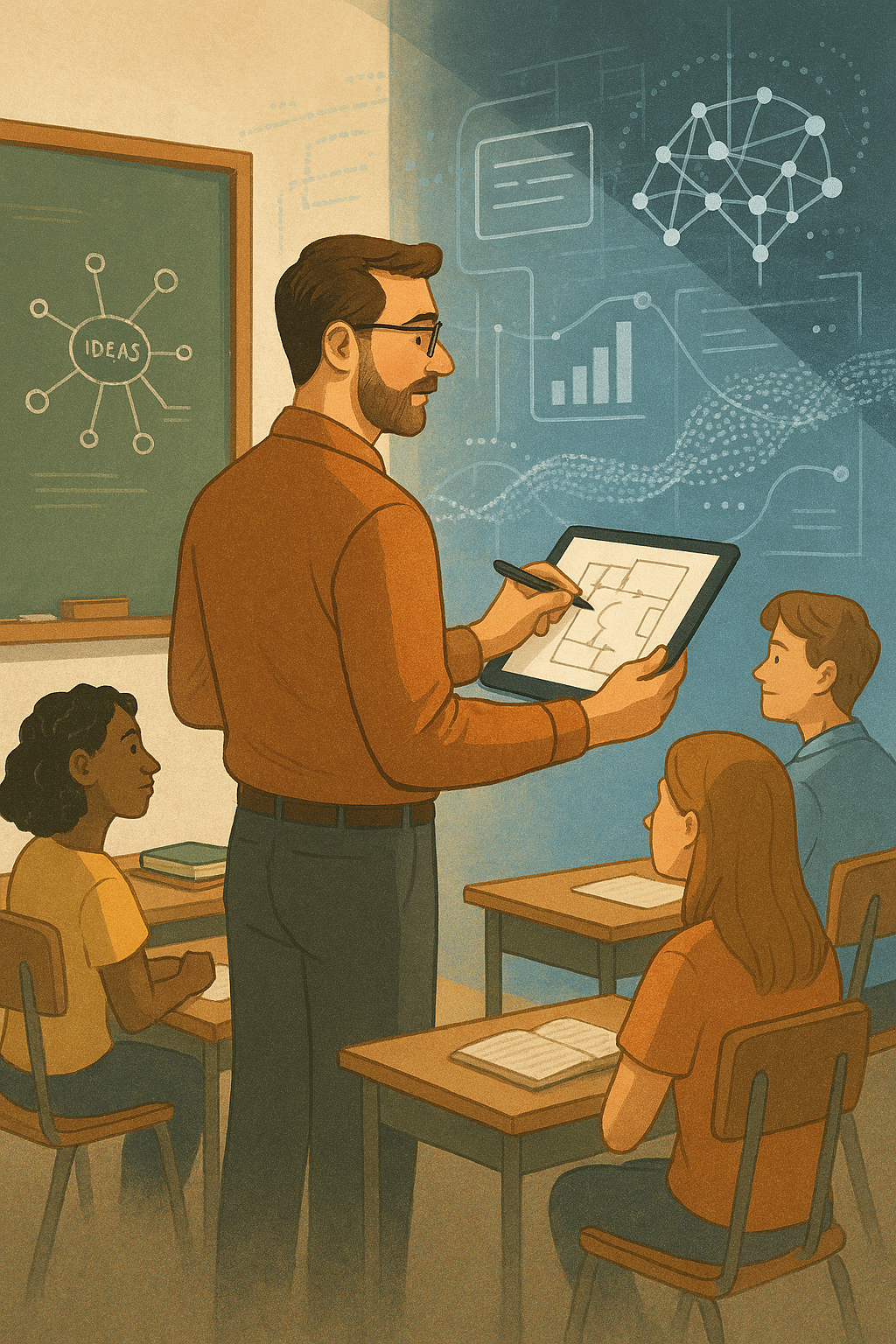
What truly matters is who defines the conditions of use, and whether teachers are positioned as passive adopters of systems designed elsewhere, or as active designers of learning environments.
3. AI Cheating and the Collapse of Traditional Assessment
The rapid spread of AI-assisted cheating is often framed as a technological crisis. In reality, it is a pedagogical failure.
Journalistic and institutional reports describe how generative AI tools enable students to complete traditional assignments with minimal effort, undermining assessment practices built around static, product-oriented tasks (Kasparkevic, 2025). Yet this development exposes a deeper structural weakness: assessments that can be automated were already pedagogically fragile.
If assignments can be completed trivially by generative models, the problem lies not with the tools, but with assessment regimes that reward output over process. Working effectively with AI requires knowledge, judgment, and skill. Prompt engineering is not the absence of competence—it is a new form of it.
Students are not becoming less capable. In many cases, they are becoming more adaptive than their teachers.
The appropriate response is neither prohibition nor moral panic, but pedagogical innovation:
- tasks that require reflection and dialogue,
- transparent process logs,
- oral defense and collaborative reasoning.
Without such redesign, education risks losing not only control over assessment, but its very purpose (Kasparkevic, 2025).
4. Students, Pragmatism, and Hidden Competence
Empirical studies across different national contexts reveal a striking paradox. Students use AI extensively, yet do so with considerable practical wisdom.
A Swedish study of upper secondary students shows that learners employ generative AI selectively—primarily for conceptual understanding—while actively avoiding use cases where they distrust the technology’s reliability (Högskolan i Halmstad, 2025). Despite limited technical knowledge of AI systems, students compensate through iterative experimentation and contextual prompting.
Similar patterns emerge in British data, where students report both frequent AI use and concern that the technology can undermine effort, creativity, and deep understanding (Oxford University Press, 2025).
Crucially, students do not call for bans. They call for guidance.
This reinforces a central thesis of this essay:
AI does not reduce the need for teachers. It radically intensifies it.
Not as content deliverers, but as designers of learning environments, ethical guides, and intellectual partners (Högskolan i Halmstad, 2025; Oxford University Press, 2025).
5. Three Narratives of AI in Education: A Comparative Diagnosis
Contemporary debates on AI in education are structured around three dominant narratives, each grounded in a distinct epistemic and institutional logic.
5.1 Market-Driven Pragmatism
One narrative frames AI as an inevitable technological force whose risks and benefits must be managed pragmatically. Efficiency, scalability, and personalization dominate this perspective, while ethical concerns are treated as layers added after adoption (MIT Technology Review, 2025).
Its strength lies in realism about innovation dynamics. Its weakness lies in its tendency to underestimate pedagogical depth and relational learning.
5.2 Humanist-Normative Critique
A second narrative approaches AI through a humanist and republican lens, emphasizing cultural formation, democratic values, and the moral purpose of education. AI is framed as a potential threat to pedagogical depth and teacher autonomy, best addressed through regulation and ethical safeguards (Le Monde, 2025).
This position rightly defends education as more than an efficiency system. Yet it places excessive faith in preemptive regulation as a solution to innovation.
5.3 Professional-Governance Anxiety
A third narrative centers on the professional identity of teachers and the absence of clear institutional boundaries. AI advances faster than guidelines can be developed, leaving educators caught between policy vacuums and platform logics (Süddeutsche Zeitung, 2025).
This perspective accurately captures institutional stress, but often lacks imagination regarding alternative pedagogical and economic models.
5.4 Synthesis: The Missing Position
Despite their differences, all three narratives share a common assumption: that control must come from above—from markets, states, or institutions.
This essay introduces a fourth position:
Design-led asymmetrical symbiosis,
where teachers actively shape the relationship between human intelligence and artificial systems,
and where pedagogical, economic, and ethical interests are aligned rather than opposed.
References (Annotated, APA 7)
Högskolan i Halmstad. (2025). Elever tar hjälp av AI – men inte till allt. Forskning.se.
Annotation: Empirical Swedish study demonstrating selective and strategic student use of generative AI. Supports the concept of “hidden competence” and institutional lag.
Kasparkevic, J. (2025). Rampant AI cheating is ruining education alarmingly fast. The Guardian.
Annotation: Journalistic analysis highlighting how generative AI exposes structural weaknesses in traditional assessment systems.
Le Monde. (2025). L’intelligence artificielle à l’école : promesse ou menace ? Le Monde – Digital Education.
Annotation: Normative-humanist critique emphasizing Bildung, teacher authority, and democratic values in the face of AI adoption.
MIT Technology Review. (2025). AI’s giants want to take over the classroom – at what cost?
Annotation: Technology-oriented analysis of Big Tech’s entry into education, illustrating tensions between innovation, commercialization, and pedagogical autonomy.
Oxford University Press. (2025). Pupils fear AI is eroding their ability to study.
Annotation: Student-centered report showing ambivalence toward AI use and a strong demand for teacher guidance.
Süddeutsche Zeitung. (2025). KI im Klassenzimmer: Wer zieht die Grenzen? SZ Wissen.
Annotation: Governance-focused analysis highlighting teacher role erosion and institutional uncertainty.
End of Part I