Essay From Prosthetics to Power: Augmentation as a New Class Divide Part I
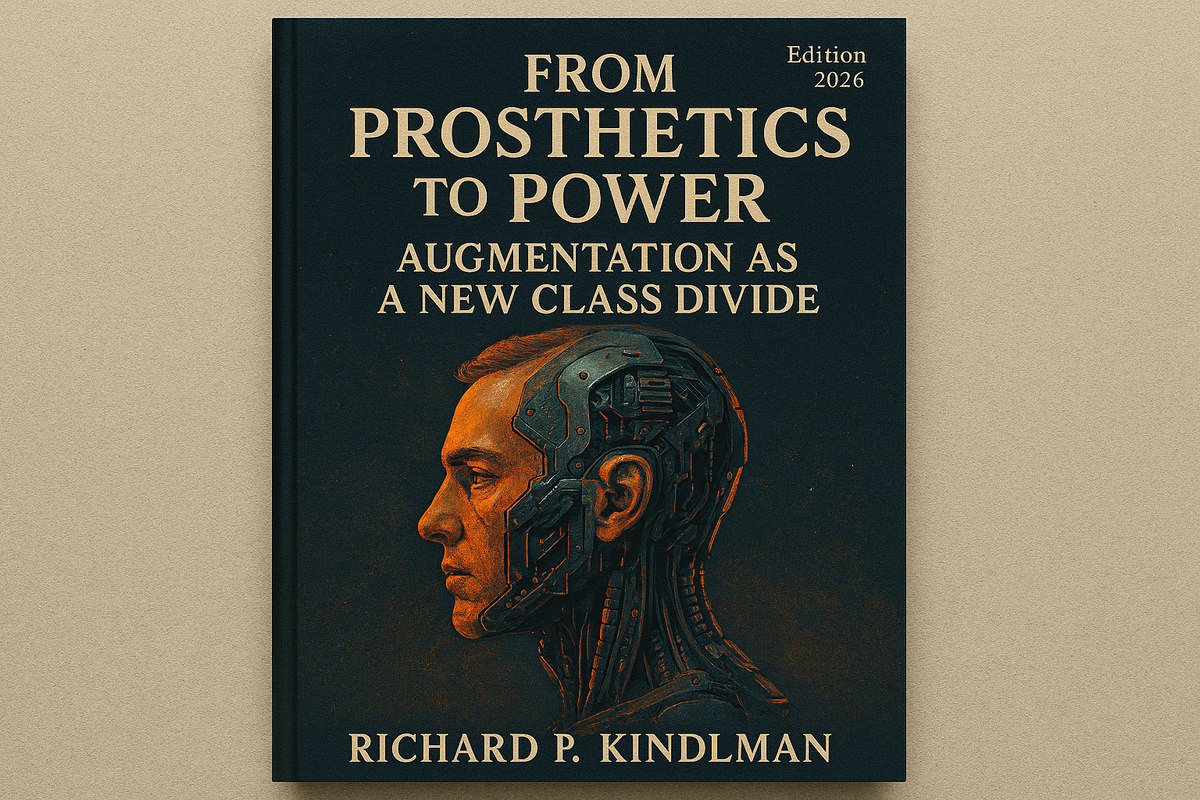
Edition 2026
A forward-looking impact analysis of the AI era’s impact on our society
Richard P. Kindlman
A Manifesto — Daring to Think Bigger
In Our Final Invention, James Barrat draws attention to a fundamental misunderstanding that continues to shape public discourse on artificial intelligence: the belief that computers process information in the same way humans do — “unless there is something mystical or magical about human thinking.”
The core postulate that runs through all my writing begins precisely here:
Human thinking is not merely a process. It is awe-inspiring, mysterious, and genuinely magical — the unique human capacity to create new knowledge out of nothing.
This is the decisive distinction between humans and artificial intelligence.
AI can recombine, optimize, and scale what already exists. Humans alone can imagine, innovate, and transform abstraction into reality.
This essay is built on that distinction. It is an invitation to explore a frontier where cognition, biology, and computation converge — and to understand what is at stake when that frontier becomes a marketplace. I am writing to remind you that the human mind is not finite, and to help cultivate it so that it bears abundant fruit rather than being quietly harvested.
When the Body Becomes a Platform for Code
We are entering a biological revolution that challenges the very definition of humanity. For centuries, technology remained external to the body — tools we held, machines we operated, systems we controlled from a distance. That boundary is now dissolving.
The body is no longer a biological endpoint. It is becoming a platform for code.
A node in an expanding network where flesh and circuitry begin to merge.
This shift is no longer speculative. Brain–computer interfaces now allow direct communication between neural activity and digital systems. What began as experimental neuroscience has moved into clinical application and early commercialization. The implications extend far beyond medicine.
This is a paid essay, available for a one-time payment of 10 EUR
https://www.kindlman.blog/essay-from-prosthetics-to-power-augmentation-as-a-new-class-divide-part-i/
At one level, these technologies promise restoration: speech for patients with ALS, movement for individuals with paralysis, relief for those suffering from Parkinson’s disease. At another level, they open the door to augmentation — accelerated learning, enhanced memory, and new forms of cognitive capacity that were once the domain of fiction.
In parallel, cybernetic prosthetics and exoskeletons no longer merely replace lost function. They enhance strength, endurance, and precision, pushing the human body beyond its natural limits in both medical and industrial contexts. Sensory augmentation follows close behind: vision beyond the visible spectrum, artificial perception layers, and haptic interfaces that create entirely new sensory channels.
In research laboratories, biohybrid systems — circuits intertwined with living neurons — point toward hybrid forms of intelligence in which the boundary between organism and machine becomes increasingly ambiguous.
This is not a future scenario. It is an unfolding transformation that forces a defining question:
Will augmentation become a new form of freedom — or the next great class marker?
From Capability to Power
When bodily capacity can be purchased, when cognitive advantage becomes a product, and when enhancement migrates from therapy to optimization, a new social order begins to take shape.
Power is no longer measured solely in capital, land, or institutional authority.
It is measured in the code embedded in flesh.
As I expressed in an earlier artistic formulation:
“Your mind, your precious — bought and sold on the market.”
This captures the deeper shift now underway. The AI-symbiotic economy transforms human creativity from an existential faculty into a tradable resource. Intellectual Capital — the capacity to generate insight ex nihilo — is no longer confined to the individual who possesses it. Once externalized, measured, and embedded in systems, it becomes transferable, scalable, and ownable.
This is the point at which augmentation ceases to be merely technological and becomes structural.
Creativity as Commodity
Classical political economy treated labor as the primary source of value. Industrial capitalism extracted surplus from physical work, time, and effort. The emerging economy operates on a different axis.
Here, value is extracted not from muscle, but from cognition — from attention, creativity, and the ability to generate novelty. What is being capitalized is not output alone, but the conditions of thinking itself.
This marks a qualitative break rather than a simple continuation of earlier exploitation models. The human being is no longer primarily a worker or even a knowledge holder, but a site of potential emergence. When augmentation technologies interface directly with cognition, that potential becomes legible, measurable, and increasingly governable.
This is not a neutral development. It reorganizes the relationship between individual, market, and power at a fundamental level.
Trend Analysis: Augmentation Technologies
- Rapid acceleration of neurotechnology, prosthetics, and biohybrid systems
Neural interfaces, sensory augmentation, and neuron–chip integration are advancing at unprecedented speed. - Key industry actors
Neuralink; Synchron; OpenBCI; Össur; Cyberdyne; Second Sight; Cochlear. - Core technological trajectories
- Brain–computer interfaces for communication and control
- Cybernetic prosthetics and exoskeletons
- Sensory extensions beyond natural perception
- Biohybrid circuits combining biological and artificial substrates
These developments do not evolve in isolation. Together, they form the infrastructural basis for a new stratification logic.
Neural Interfaces: From Therapy to Cognitive Elitism
Brain–computer interfaces are often framed as emancipatory technologies — tools that restore autonomy to those who have lost it. This framing is accurate, but incomplete.
The same technologies that enable recovery also enable enhancement. What begins as medical necessity risks becoming competitive advantage. When neural augmentation moves from treatment to optimization, access becomes decisive.
The cost, invasiveness, and technical complexity of BCIs ensure that access will be uneven. Cognitive enhancement, if commodified, will amplify existing inequalities and create new ones. We move toward a condition that can best be described as neurocapitalism — a system in which brain capacity itself becomes a market asset.
The ethical questions multiply accordingly. Who owns neural data? What happens when thought patterns are recorded, analyzed, or monetized? Where does autonomy end when enhancement becomes implicit expectation rather than free choice?
Early legislative efforts gesture toward concepts such as neuronal sovereignty and mental integrity, but governance remains fragmented and reactive. The pace of technological development far outstrips the pace of ethical and legal reflection.
A brain–computer interface is therefore not merely a device.
It is a political and philosophical rupture.
Critical Analysis: Augmentation and Control
The deeper risk is not coercion, but normalization. Control in the industrial age relied on force, discipline, and visible authority. Control in the symbiotic age operates through convenience, optimization, and voluntary adoption.
When technologies promise efficiency, clarity, and competitive survival, refusal becomes costly. Enhancement shifts from option to obligation. What begins as empowerment risks becoming quiet compulsion.
This raises a fundamental philosophical question:
Can we still speak meaningfully of free will when the conditions of thought itself are technologically mediated and potentially modifiable?
There is also a cultural dimension. Narratives of self-optimization transform enhancement into moral duty. Human dignity risks being redefined in terms of neural performance rather than intrinsic worth.
This is the true class divide introduced by augmentation: not between rich and poor, but between those who can shape the architecture of intelligence — and those who must live within it.
Closing Reflection
Augmentation is not inherently dystopian. But it is never neutral.
Whether it becomes a pathway to expanded human freedom or a mechanism of stratification depends not on technology itself, but on how power, access, and agency are designed.
That question cannot be postponed.