Essay Teacher as Designer: Att bygga symbiotiska AI-klassrum (v06)
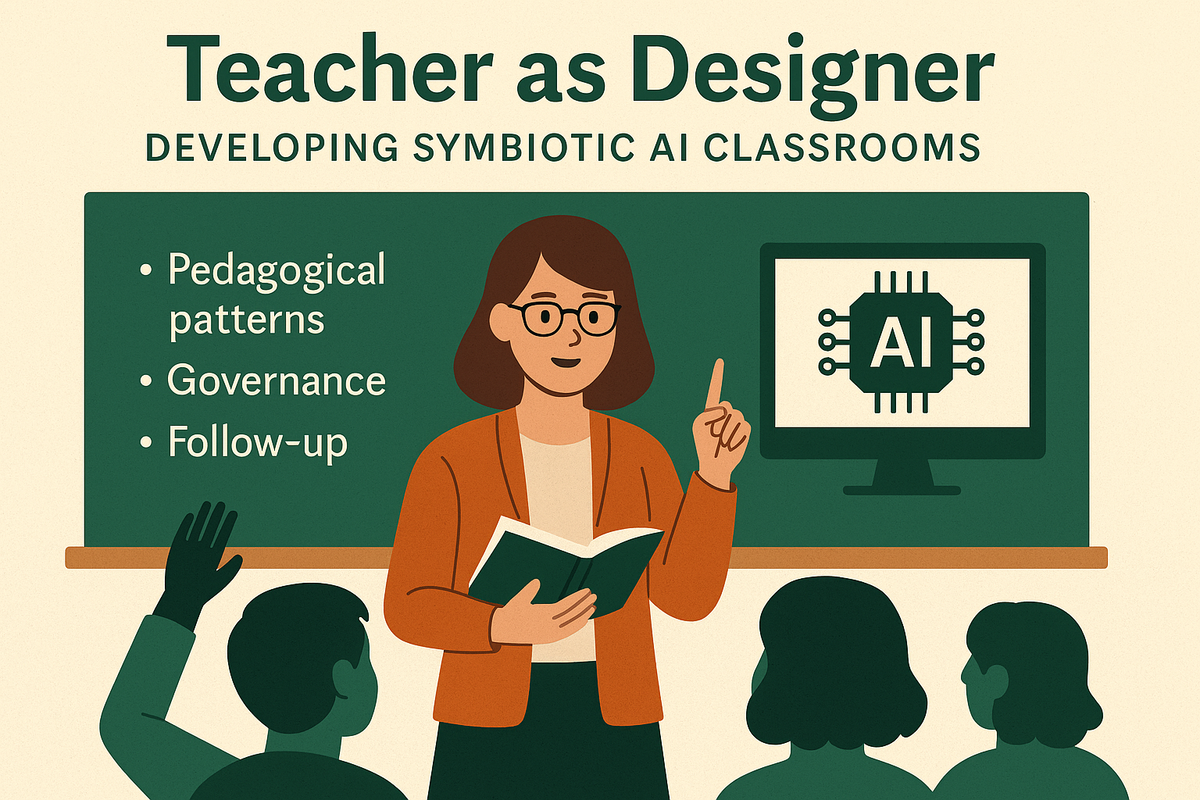
Prologue — Two Mornings, Two Classrooms
Morning one:
the absence list grows before anyone opens a laptop. The noise level rises in the absence of ritual — a teacher fumbling with the latest 'app' while students have already moved on to another feed. It looks like activity but feels like absence. AI? It becomes just another tool slipping through the fingers because the foundation is missing safety, clarity, and measurable process.
Morning two:
the door opens to a calm design. The transparency log is already on the board (prompt → output → error/bias → revision → reflection → teacher comment). The class knows each assignment follows the Triple Check: AI draft → peer critique → teacher validation. Two micro-goals are visible, mini-rubrics for process artifacts are in place, and two micro-conferences await at the end. It is not the technology that creates order — it is the teacher’s design that carries the technology.
The difference is stark: the first classroom is ruled by chance, the second by pattern.
This is a paid essay, available for a one-time payment of 10 EUR.
👉 [Click here to purchase and unlock the full text]
https://www.kindlman.blog/essay-teacher-as-designer-att-bygga-symbiotiska-ai-klassrum-v06/
Teacher as Designer is not a slogan — it is a method that makes AI a servant, not a master. Hype-in-the-loop is dangerous; human-in-the-loop is essential.
Part 1 — Why Teacher as Designer? Principles before Platforms
When policy lags and Big Tech sell solutions with vested interests, it is dangerous to outsource judgment and ethics to vendors. Education demands human agency, transparency, and local evidence — in that order.
UNESCO’s framework for AI competence outlines a teacher's journey from acquire (basic understanding) to deepen (integrated practice) and create (local innovation). It is a moral compass for human-centered, transparent, and responsible pedagogy. Without this posture, “AI initiatives” risk becoming yet another reform wave without effect.
Interviews with school leaders reveal a desire for guidelines, AI literacy, and support for teacher work — but waiting has become a habit. Students already use AI. The conclusion is provocative but necessary: stop waiting, start designing. Make the classroom vendor-agnostic with patterns, artifacts, and red lines, so that learning is measurable even when platforms shift.
“We see more immediate benefits and fewer risks from teacher-facing use of generative AI” (UK Department for Education, 2024).
Teachers and schools often fear students using AI for cheating. This fear reveals a pedagogy that hasn’t kept pace with technological shifts. Assign oral follow-ups to written tasks — and use them as a moment to model AI literacy in action. Traditional assessment no longer suffices:
“As head of an exam board (OCR), I am well aware of how serious this issue is… We cannot put generative AI back in its box… the proper use of this technology will be a vital skill in their working lives” (Duffy, 2025).
“Rather than banning generative AI from the classroom, we need to rethink the educational process… much like we did years ago for mathematics education when cheap calculators became available” (Swartout, 2025).
Yet policymakers remain unprepared. There is little guidance, no methodology. Educators are left to build the bridge while walking.
The Teacher’s Crucial Role
“As artificial intelligence transforms education, it presents a paradox where the benefits of efficiency and innovation may come at the cost of the human connection that is so vital in teaching” (MIT Technology Review, 2025).
AI is tireless — students are not. Teachers must step in to set limits, frame processes, and safeguard meaning. Not just to assess — but to protect the integrity of student thinking.
Student Perspectives on AI: Voices from the Classroom
In a large study by Johnston et al. (2024), involving over 2,500 students, learners expressed nuanced perspectives: AI is helpful for structure and exploration, but many worry about losing their voice. They want guidance and clear policies.
Forskning.se (2025) shows that Swedish students, even without deep technical knowledge, selectively use AI. They appreciate it for organization or inspiration but reject it when emotional tone or personal judgment is required.
A UK-based survey in The Guardian (2025) found that most students fear AI weakens their ability to learn and think independently. Yet they do not reject it — they request teacher presence to help make sense of it.
Ethics, Profession, and the Teacher’s Role in AI Classrooms
Stolpe (2024) explores how teachers face ethical dilemmas beyond what technology policies account for — the tension between efficiency and presence, control and autonomy. Ethics, the author argues, must be rooted in reflective pedagogy.
The EdAider study (2025) shows how professional development builds not only AI competence, but also the capacity for ethical reflection and pedagogical discourse among teachers.
Axelsson (2024) adds a broader view: as EdTech grows, teacher autonomy shrinks — unless educators formulate their own ethical stance. Silence risks moral erosion.
Part 2 — Belonging Before Tools: Why the Foundation Comes First
On paper, AI seems like a savior: it can differentiate material, support planning, and offer feedback. But many school days begin not with plans — but with absence. According to the UK Department for Education (2024), teacher-focused AI use is safer and more effective than student-led use, precisely because human judgment is required when classroom conditions shift.
Philipson reminds us: persistent absenteeism signals a crisis in belonging. But the same design logic that makes AI ethical — transparency, ritual, predictability — also builds a classroom culture of care.
Part 3 — Local Governance and Teacher as Designer:
Stop Waiting, Start Designing
School leaders want guidance. But policy is slow. In the meantime, teacher-led local governance is the most viable strategy. Swartout (2025) and MIT Technology Review (2025) both stress the danger of weak evidence and unchecked vendor influence if teachers relinquish design authority.
Part 4 — Students' Attitudes: Excited, Skeptical, or Worried?
Alpizar-Chacon et al. (2025) document diverse emotional responses to AI. Younger learners are often curious and enthusiastic. Older students tend toward skepticism, sometimes even distress. The study underscores the need for differentiated AI pedagogy based on developmental stage and context.
Part 5 — Ten Commandments for Symbiotic AI Pedagogy
- Preserve the student’s voice.
- AI must never become the end goal of learning.
- Make the process visible.
- Keep human judgment central.
- Protect the student’s emotional life.
- Design AI tasks that demand reflection.
- Show the log — not just the result.
- Allow experimentation, not coercion.
- Always ask: what if AI disappears?
- Cherish what AI cannot replicate: empathy, ethics, intuition.
Part 6 — Mastery Assessment and Equity: Measurable Symbiosis
For symbiosis to be more than rhetoric, assessment must track both process and quality. Mastery assessment provides a framework for aligning clear learning goals with student-created artifacts — evaluating both how and what they produce.
Part 7 — Case Study Framework: Local Applications of Symbiotic Pedagogy
Title: Between Hype and Reality: AI and Teacher Design in a Swedish High School Classroom
Methodology:
- Qualitative interviews with 2–3 teachers
- Short observation of AI-assisted assignment
- Student reflections via exit tickets or small-group dialogue
Key Questions:
- How do teachers plan for AI use without losing pedagogical control?
- How do students respond to the transparency log and Triple Check?
- Is AI experienced as a help or a burden?
Potential Quotes:
- “I use AI as a colleague, not as a guru.”
- “Once I showed them what the prompt did, they started understanding the process.”
- “It was the AI that asked too many questions — I felt overwhelmed.”
Analysis:
- Tension between structure and overload
- AI as motivator vs. cognitive distraction
- The need for teacher-led design to ensure balance between autonomy and guidance
Shared Lessons from Both Studies
These insights are critical for shaping future policy and practice. They shift the focus from technological hype to sustainable design, legal safeguards, and evidence-based development. Without these principles, AI risks amplifying inequalities and creating uncertainty rather than supporting learning.
- AI is not a miracle app – it is a design question.
Technology only works when embedded in pedagogical patterns that make learning visible and meaningful. - Governance kit (disclaimers, logs, red lines) is essential for fairness and legal integrity.
Without local governance mechanisms, AI use becomes random and risks undermining both ethics and quality. - Follow-up is required: Both studies plan to measure long-term effects on learning and motivation.
Evidence is the only way out of hype. Systematic follow-up enables continuous adjustment and improvement of design.
Epilogue — It Wasn’t the App — It Was the Design
There will be many campaigns about how AI “changes everything.” But in the classroom, the truth is simpler and sharper: no tool replaces human judgment, structure, and ethics. It wasn’t the app — it was the design. And that design began with the teacher.
Design is not a PowerPoint or policy. It is a sequence of actions — the log on the board, the Triple Check ritual, red lines as safeguards, micro-goals that bring meaning. It’s small steps that make the difference between hype and sustainability.
References (APA)
Alpizar-Chacon, R., et al. (2025). Excited, skeptical, or worried? A multi-institution study on student attitudes toward generative AI. arXiv. https://arxiv.org/abs/2510.03107
Axelsson, K. (2024). Skolans digitalisering, AI och lärarrollen. Pedagogisk Forskning i Sverige, 29(1), 19–35. https://publicera.kb.se/pfs/article/view/53477
Duffy, J. (2025). AI belongs in classrooms – with humans at the center. University of Cambridge. https://www.cam.ac.uk/stories/jill-duffy-ai-education
EdAider. (2025). EdAiders AI-utbildning för lärare. https://www.edaider.com/kunskapsbank/EdAiders-AI-utbildning
Forskning.se. (2025). Elever tar hjälp av AI – men inte till allt. https://forskning.se/2025/02/27/elever-tar-hjalp-av-ai-men-inte-till-allt
Johnston, L., et al. (2024). Student perspectives on the use of generative artificial intelligence technologies. International Journal of Educational Technology in Higher Education, 21(1). https://link.springer.com/article/10.1007/s40979-024-00149-4
MIT Technology Review. (2025). AI’s giants want to take over the classroom – at what cost? https://www.technologyreview.com/2025/07/15/1120086/ais-giants-want-to-take-over-the-classroom
Stolpe, L. (2024). AI and ethical dilemmas for teachers. Atena Didaktik. https://atenadidaktik.se/article/view/5518
Swartout, W. (2025). Generative AI and Education: Deny and Detect or Embrace and Enhance? USC News. https://today.usc.edu/ai-in-the-classroom-how-teachers-make-ethical-judgments/
The Guardian. (2025). Pupils fear AI is eroding their ability to study. https://www.theguardian.com/technology/2025/oct/15/pupils-fear-ai-eroding-study-ability-research
UK Department for Education. (2024). Generative artificial intelligence (AI) in education. https://www.gov.uk/government/publications/generative-artificial-intelligence-in-education