Essay Teacher as Designer Part II: Symbiotic AI Classrooms
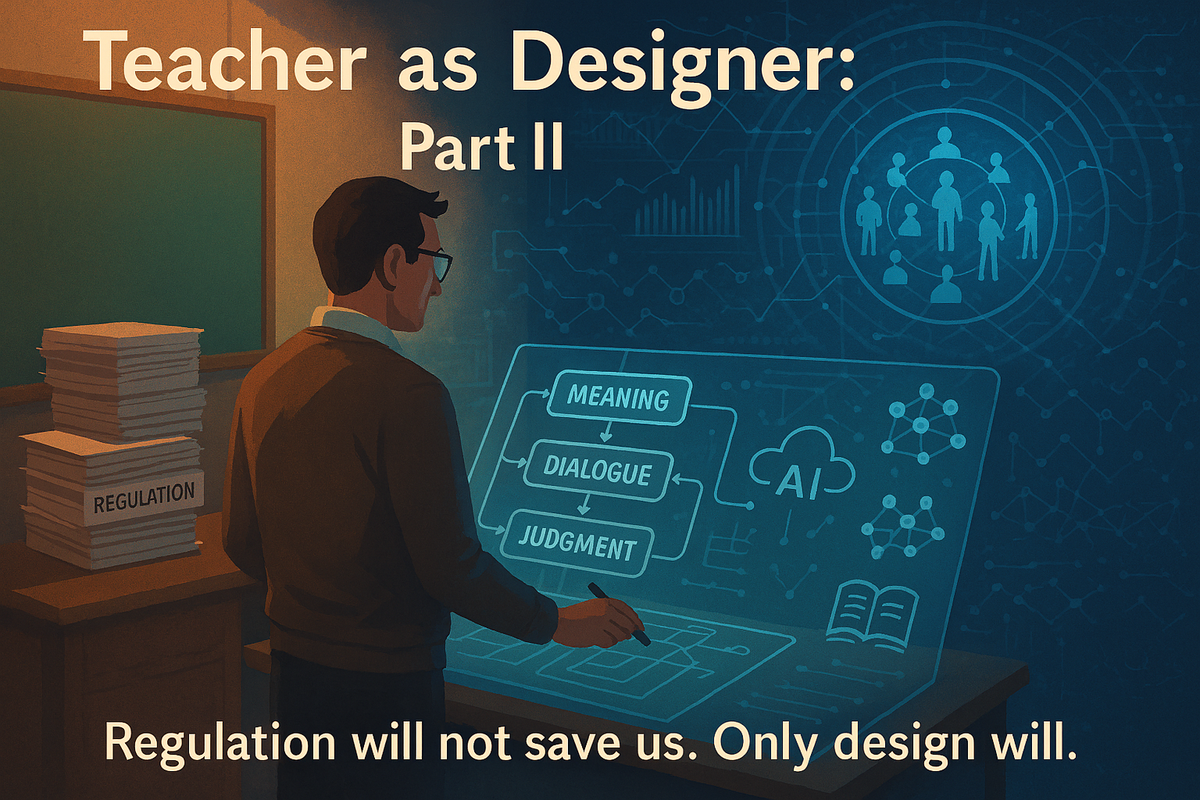
Part II – Construction: Designing Symbiotic AI Education
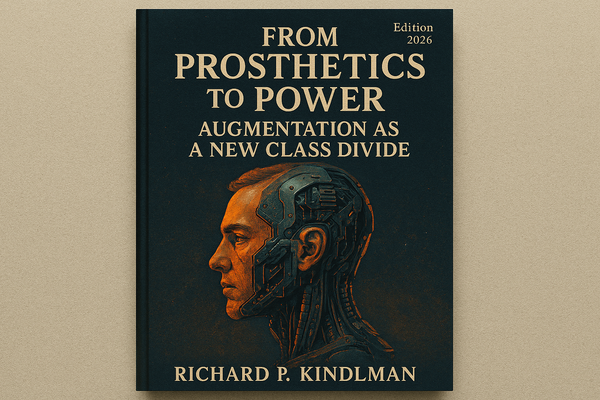
Richard P. Kindlmann
Edition 2026
A Manifesto for Human-Centered Intelligence
Human thinking is not merely a process of information handling. It is a generative, relational, and profoundly human act. In the classroom, thinking becomes a shared intellectual and ethical practice—one in which meaning emerges through dialogue, uncertainty, and lived experience.
This marks the essential distinction between artificial intelligence and the human mind. AI reorganizes and recombines existing information through algorithmic pattern recognition. Teachers and students, by contrast, create knowledge that did not previously exist—through interpretation, judgment, and mutual presence.
This essay is grounded in a simple but demanding postulate:
AI must be designed into education in ways that deepen human thinking, not replace it.
This is a paid essay, available for a one-time payment of 10 EUR.
👉 [Click here to purchase and unlock the full text]
https://www.kindlman.blog/essay-teacher-as-designer-symbiotic-ai-classrooms/
The question, therefore, is not whether AI belongs in the classroom. It already does. The real question is who designs the relationship between teacher, student, and technology—and according to which values.
Beyond Control: Why Regulation Alone Will Fail
Modern societies often cling to the belief that regulation can precede innovation. Yet history shows the opposite: technological transformations consistently outpace political and bureaucratic frameworks. AI is no exception.
Three misconceptions dominate today’s debate:
- That policy can anticipate technological leaps.
Innovation rarely unfolds along predictable lines. Attempts to govern AI preemptively risk constraining its positive potential. - That political oversight is inherently more legitimate than commercial interest.
Both state and market actors pursue power, influence, and advantage. Neither position is neutral. - That stricter regulation ensures pedagogical integrity.
Overregulation may stifle precisely the kind of pedagogical creativity that is urgently needed for schools to adapt.
European discussions often express concern that AI technologies reduce learning to measurable outputs and threaten the humanistic traditions of education. These concerns are real and important. Yet the proposed remedy—comprehensive regulation—rests on an assumption that freedom of pedagogical experimentation is a danger rather than a necessity.
Regulation has its place. But regulation cannot substitute for design.
The relationship between teacher, student, and intelligent technologies must evolve organically, shaped by pedagogical judgment rather than rigid compliance mechanisms. In practice, innovative teaching environments must emerge first; governance should follow, not the reverse.
The real risk is not deregulation, but politicization. When states or partisan actors position themselves as protectors of students against “commercial threats,” AI risks becoming a tool of political influence. A system controlled by political interests is no less vulnerable than one captured by corporate incentives.
Thus, the central challenge is not to build stronger walls around education, but to design better relationships among the actors who shape it.
7. From Opposition to Alignment: Academia and Big Tech as Co-Designers
Public discourse often frames academia and technology companies as opposing forces — one defending cultural and intellectual heritage, the other driven by commercial ambition. This dichotomy is misleading.
In reality, their long-term interests are not contradictory:
- Academia seeks durable knowledge, intellectual legitimacy, and human development.
- Technology companies seek scalable solutions, innovation, and long-term users.
- The labor market seeks adaptable, competent individuals capable of working symbiotically with intelligent tools.
The conflict arises not from incompatible goals, but from misaligned incentives. Each actor currently benefits from short-term sub-optimization:
- universities defend structures inherited from the industrial age,
- tech companies optimize for rapid expansion,
- employers expect immediate readiness without investing in development.
The result is a dysfunctional system in which no actor is incentivized to cultivate true educational symbiosis.
A more promising path is one in which academia and industry become intentional partners, not accidental adversaries. Such collaboration would not erode educational values but reinforce them—provided it is guided by pedagogical design rather than market pressure alone.
This shift requires new principles for cooperation, grounded in mutual responsibility, long-term value creation, and explicit pedagogical frameworks.
In such a system, neither academia nor Big Tech dominates; instead, they co-design the infrastructures in which human learning unfolds.
8. A New Economic Model: Education as a Lifelong Symbiotic System
If education is to serve a rapidly evolving society, it cannot remain a front-loaded, time-limited experience. Instead, it must become a lifelong infrastructure, supported by a sustainable economic model.
A symbiotic knowledge economy would operate through the following mechanisms:
- Education as foundational infrastructure rather than a finite product.
Learning becomes a continuous process that extends throughout a person’s working life. - Tech companies invest before employment begins.
Their role is not to dictate pedagogy but to provide technologies, data architectures, and learning tools — under pedagogical direction. - Employers contribute once skills materialize.
Upon hiring, employers would pay a “gratitude fee” to both the educational institution and the technology provider that contributed to the individual’s development. This aligns incentives across the entire knowledge cycle. - Periodic returns to education.
Every few years, the employee returns to structured learning environments for reskilling or deepening. Costs and benefits are shared across school and industry. - Shared risk, shared cost, shared return.
The system distributes responsibility across all stakeholders. Teachers, schools, tech companies, and employers collaborate in the cultivation and renewal of human capability.
This model is not an expression of neoliberalism.
It is a new form of intergenerational knowledge economy, in which value flows not only from individuals to institutions, but among institutions themselves — reflecting the distributed nature of intelligence in an AI-augmented society.
The goal is simple:
to build an educational ecosystem where long-term human development becomes economically rational.
9. The Teacher Revisited: From Instructor to Epistemic Architect
If education systems respond to the AI transition with foresight, the teacher’s role will transform profoundly.
The teacher of the AI era is not:
- a platform operator,
- a distributor of pre-packaged content,
- or a functionary in an algorithmic workflow.
Instead, the teacher becomes an epistemic architect — the designer of intellectual environments in which human judgment, ethical reasoning, and relational depth can flourish.
This role includes:
- curating AI tools rather than competing with them,
- defining the boundaries of machine assistance,
- ensuring that meaning, not merely information, remains central,
- cultivating processes that foreground reflection, dialogue, and critical agency.
In short: teachers preserve and expand what cannot be automated.
Their authority becomes more—not less—important in an AI-rich world.
10. Risks, Objections, and Why Inaction Is Worse
Concerns about Big Tech dominance, corruption of education, and rising inequality are legitimate. But these risks already exist within the current trajectory. Ignoring them will not prevent their expansion; it will accelerate it.
If educational institutions, policymakers, and unions fail to act, the vacuum will be filled by actors with far greater resources and clearer incentives. Under such circumstances:
- labor markets will be shaped by technological imperatives rather than pedagogical ones,
- educational standards will drift toward corporate priorities,
- and inequality may deepen as those equipped for symbiotic learning pull further ahead.
The question is not whether risks exist, but which risks accompany action versus inaction.
A design-led approach does not eliminate risk, but it brings risks into the open — where they can be shaped, moderated, and governed by shared principles.
11. Dialectics as a Driving Force
The emerging AI-symbiotic economy resembles earlier historical transitions, propelled not by smooth evolution but by dialectical tensions.
Unity and conflict of opposites
New systems arise through the interplay of competing forces:
industrial-era institutions and emerging symbiotic structures, stability and disruption, knowledge preservation and knowledge acceleration.
Quantitative shifts leading to qualitative change
As accumulated knowledge becomes a form of tradable intellectual capital, a structural shift occurs. Education evolves from a public service into a distributed, value-generating ecosystem.
Creative transformation
Traditional institutions that cannot adapt — including universities, bureaucracies, and political systems — may lose relevance as new symbiotic formations take root.
Ibn Khaldun’s observations on civilizational cycles offer a cautionary reminder:
institutions in comfort tend to stagnate. Renewal often arises from the periphery, not the center.
In the context of AI, a new class structure may form — not based on income or birth, but on capacity for symbiotic intelligence:
- The Class of Free Citizens (AI-Symbiotics): creators of intellectual capital, capable of shaping technological systems rather than being shaped by them.
- The Associative Class: intermediaries and specialists who enable coordination across the symbiotic ecosystem.
- The Working Class (Gig Economy): skilled contributors whose labor is valuable but not directly integrated into symbiotic knowledge production.
- The Displaced Class: individuals unable or unwilling to adapt to the demands of the new system.
This classification is not normative. It is an analytical projection — a map of potential social structures emerging from technological and economic dynamics.
Understanding these forces is essential for designing systems that support broad participation rather than widening divides.
Conclusion: From Fear to Design
AI technologies do not mark the end of education.
They mark the end of the illusion that the structures inherited from the industrial era are sufficient for the world ahead.
The future will not belong to those who prohibit technological change,
nor to those who exploit it without responsibility.
It will belong to those who design the relationships between humans and intelligent machines with clarity, foresight, and ethical purpose.
Education’s task is no longer to defend the past,
but to architect the conditions for human flourishing in a symbiotic age.