Essay_Part 4B_Symbiosis in Schools: Humans and AI as a Collaborative Force
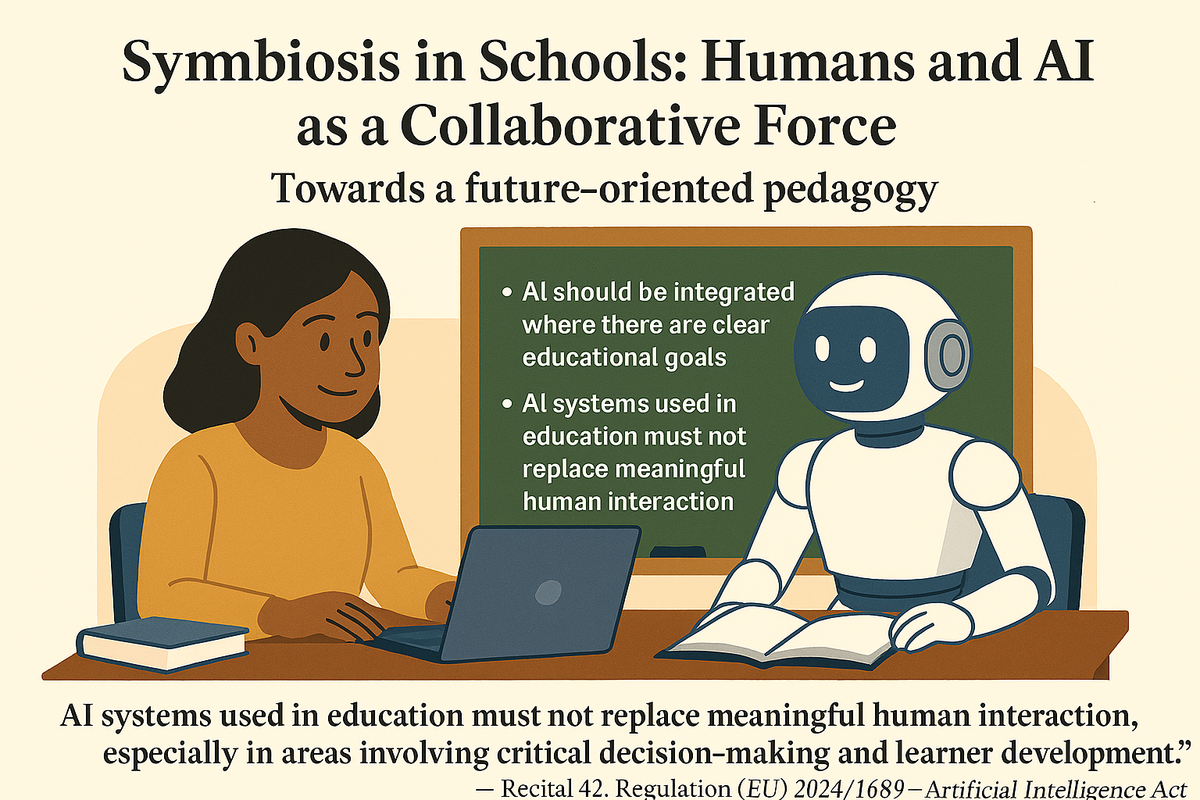
Subtitle: Towards a future-oriented pedagogy
AI should be integrated where there are clear educational goals
“The more ambitious our pedagogy, the more intelligent and humane our use of AI must become. Technology follows values—or else it undermines them.”
— Tom Chatfield, 2025, AI and the Future of Pedagogy
“AI systems used in education must not replace meaningful human interaction, especially in areas involving critical decision-making and learner development.”
— Recital 42, Regulation (EU) 2024/1689 – Artificial Intelligence Act
As Tom Chatfield argues, AI should be integrated into education only when it serves clear learning goals. This means asking not just what AI can do, but what students should learn—and how AI can support that process without undermining deeper thinking or ethical responsibility.
This is a paid essay, available for a one-time payment of 10 EUR.
👉 [Click here to purchase and unlock the full text]
https://www.kindlman.blog/essay_part-4b_symbiosis-in-schools-humans-and-ai-as-a-collaborative-force/
AI systems must remain tools, not tutors. Their purpose is to expand capacity, not to automate learning. They are best used in areas like revision, simulation, or perspective broadening. Chatfield warns against substituting AI for pedagogical purposes. Instead, integration must be intentional and reflective.
Assessment should be mastery-based, not monitoring-based
Current assessment systems often favor compliance over creativity. Chatfield advocates for mastery-based assessment: evaluating how well students understand and can apply concepts, not just what they can reproduce.
AI can assist here—through feedback, revision cycles, and simulation—but the final judgment must remain human. Symbiotic classrooms emphasize growth over performance. They create space for students to explore, fail, reflect, and improve.
Technology use should be anchored in an ethical and societal mission
Education is never neutral. The technologies we adopt carry values. Chatfield emphasizes that AI use must align with civic and ethical goals: inclusion, equity, autonomy, and dignity.
This means involving students in conversations about what AI is, what it does, and what it should be allowed to do. Pedagogical symbiosis includes AI literacy, but also critical AI ethics. Schools must help students not only use AI, but also question it.
Institutional culture: From defensive to experimental
The biggest barrier to educational transformation isn’t technology—it’s culture. Many institutions still operate defensively: banning new tools or adopting them uncritically.
Chatfield calls for a shift: towards experimental, feedback-driven, ethically grounded institutions. Schools should become labs for democratic learning—with teachers as co-creators, not tech enforcers.
EU’s AI Act – Barrier or Opportunity?
The EU AI Act classifies education-related systems as ‘high-risk,’ requiring transparency and human oversight. Emotion analysis of students is prohibited, but AI support for writing, simulations, and feedback is allowed under teacher supervision. The challenge: the EU often appears regulation-driven rather than vision-driven. The solution: interpret the law as a framework for responsible innovation – not as a barrier.
Digital Exclusion – The New Divide
Ignoring AI literacy in schools creates a new form of digital exclusion. OECD and Australian studies show that socioeconomically disadvantaged students have less access to digital tools. If AI becomes standard in working life but not in schools, inequality will deepen. Symbiosis is therefore also a matter of equity.
Practical Symbiosis: School Projects That Work
NOLAI – Netherlands: A national lab connecting schools, universities, and companies to develop AI prototypes for classrooms. Example: A reading comprehension coach that generates questions at different levels. Teachers select the flow and add deeper questions. Pedagogical core: Students write meta-reflections on which AI-generated questions were relevant and why. This trains critical judgment and self-regulation.
AI4T – France, Ireland, Italy, Luxembourg, Slovenia: An Erasmus+ project offering MOOCs and an open textbook for 1,000+ teachers. Example: Language classes use machine translation as a draft generator. Students compare, improve, and justify choices. Pedagogical core: Contrast exercises between AI text and human-improved text strengthen language awareness and critical review.
Deep-Dive Box 1: AI-Socrates – Critical Dialogue
Purpose: Train argumentation and source criticism. Setup: AI generates counter-questions on a historical theme. Students select relevant questions, justify choices, and build their own reasoning. Pedagogical core: AI expands perspectives, but students own the content. Teachers assess logic and sources.
Deep-Dive Box 2: Prototype Studio – Project-Based Learning
Purpose: Combine creativity and data-driven exploration. Setup: Students define a local problem. AI helps with idea generation and simulations. Students compare AI suggestions with their own measurements. Pedagogical core: Focus on comparison and reflection – not on accepting AI’s answers.
Deep-Dive Box 3: Writing Coach – Metacognitive Writing Process
Purpose: Strengthen structuring and revision skills. Setup: AI suggests structure and style. Students choose, rewrite, and annotate why certain suggestions are good or bad. Pedagogical core: The process becomes visible, and assessment focuses on reasoning, not just the final product.
Policy Appendix: Practical Recommendations for Schools
A. Governance and Compliance: Define permitted use cases, human-in-the-loop as standard, data protection and logs.
B. Pedagogy and Assessment: Mastery-based assessment, reflection cards, critical source review.
C. Infrastructure and Equity: Access guarantee, teacher CPD with testbeds, open resources.
D. Communication: Transparency sheets and student contracts.
E. Follow-up: Annual pedagogical review and student panels.
Implications and the way forward
- Promote AI literacy as a civic skill
- Support teachers as designers, not just implementers
- Build open, adaptable infrastructures with strong privacy safeguards
- Assess what matters: thinking, reflection, judgment
- Move from fear to responsibility—from banning to guiding
Commented Reference List (from Part A)
- NOLAI (Radboud University): A national lab developing AI prototypes in schools with a focus on ethics and pedagogy.
- AI4T (EACEA): Teacher training that increases confidence and competence in AI use.
- Dr Tom Chatfield, Sage White Paper: Advocates mastery-based assessment and teachers as designers.
- EU AI Act: Risk-based model and ban on emotion analysis.
- APA Monitor: Trends in K-12 and psychological research on AI.
- Stanford SCALE: Data on AI use in teaching.
Symbiosis in schools is not about surrendering to machines. It is about shaping tools that reflect our highest values. When done right, AI in education strengthens what makes us most human.