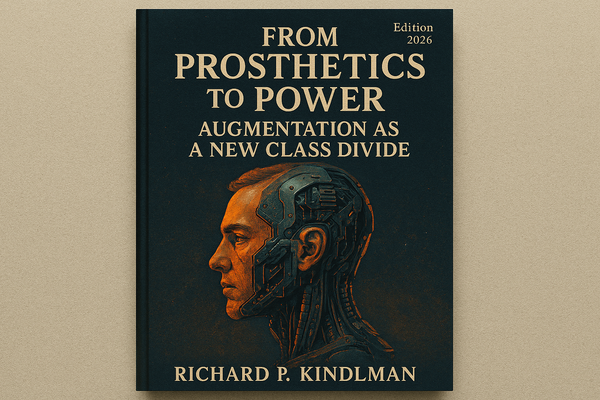
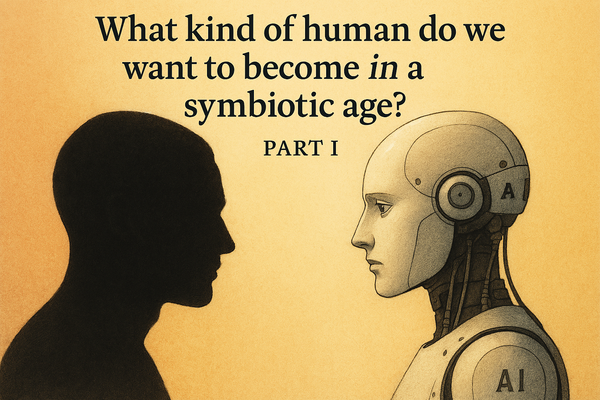
Essay_What Kind of Human Do We Want to Become in a Symbiotic Age? Part II

Prologue
Part I of this manifesto posed a foundational question: What kind of human do we want to become in a symbiotic age?
Part II begins where vision meets architecture. It is no longer enough to diagnose the illusion of neutrality or celebrate the promise of augmentation. The challenge now is praxis — how to design systems that preserve dignity, deepen consciousness, and resist the quiet drift toward optimization tyranny.
This is not a technical handbook; it is a civilizational blueprint.
For if we fail to embed ethics, literacy, and psychological depth into the code of our emerging world, symbiosis will collapse into stratification. The stakes are existential. The question persists — but in Part II, it demands action.
This is a paid essay, available for a one-time payment of 10 EUR.
👉 [https://www.kindlman.blog/essay_what-kind-of-human-do-we-want-to-become-in-a-symbiotic-age-part-ii/
Dialectics as a Driving Force
The AI-Symbiotic Economy evolves through dialectical forces:
1. Unity and Conflict of Opposites
New systems emerge from tension, not harmony.
The friction between outdated industrial structures and emerging symbiotic relationships generates creativity, innovation, and ultimately replacement.
2. Quantitative to Qualitative Leap
Accumulated knowledge is transformed into tradable Intellectual Capital (IC) — marking an irreversible economic and social shift.
3. Creative Destruction
Standalone AI systems will be eclipsed by deeper symbiotic integrations. These integrations will reshape global power structures by rewarding co-agency over automation.
This is the precise historical juncture at which we find ourselves today.
What Does the Future Hold?
A fateful question arises:
Will the transition to an AI-driven socio-economic system succeed or fail?
A common misconception imagines the future as something already fully formed, merely hidden. But the future is not waiting behind a curtain. It does not exist in a fixed, discoverable state.
The future cannot be predicted — it can only be created.
Paradigm shifts happen discontinuously, in leaps and ruptures. No analytics, no model, no forecast can determine when they will arrive or what they will transform. This uncertainty is frightening, which is why people flee into forecasting instead of leadership. Mass media amplifies this anxiety through AI-driven alarmism.
Yet one principle remains absolutely reliable:
The only way to predict the future is to create it.
Creating the future means accumulating a region’s, company’s, or nation’s IC to a critical mass through structured, intentional development. Once IC reaches this threshold, processes begin generating more change-energy than they consume, becoming self-propelling. At that moment, new value streams and entirely new sectors emerge — always positive, always transformative.
Those who achieve IC critical mass own the dynamics of the future.
They dictate terms for everyone else.
Today, a handful of American corporations already operate at this level, shaping a new socio-economic system whose parameters resemble dictation more than competition.
AI as Catalyst: Intellectual Capital Becomes the Means of Production
Every autonomous process begins with an individual — more precisely, in the individual's mind.
All IC resides in the heads of people, nowhere else.
In the AI-driven economy, the means of production are no longer external. They are not machines, land, equipment, or raw materials. They are:
- knowledge,
- insight,
- creative capacity,
- and the ability to generate new knowledge ex nihilo.
Thus every company’s next market already exists — in the minds of its people.
IC is always born in individuals. It then propagates to groups, networks, R&D teams, and ecosystems. This IC is unique: nobody else in the world has the combination of insight and experience that resides in your mind.
No one can compete with you in being you.
This shift creates a new necessity: IC must be measured, structured, and capitalized.
Just as land became a tradable commodity in Sweden during the 18th and 19th centuries, so knowledge — once embodied solely in individuals — now becomes mercantile property.
A person can possess the ability to create knowledge, but the resulting IC can be owned by others. This unlocks entirely new economic dynamics.
The Coming Transformation of the Labor Market
In an AI-driven economy:
- All means of production are in the minds of individuals.
- Groups that fail to concentrate their IC into critical mass will be eliminated in global competition.
- Those who succeed — and who are able to accumulate others’ IC — will become dominant.
This is not metaphorical; it is structural.
Those who conquer the IC of others gain power over them and will shape their development — thus their future.
Those who act within their own and others’ IC become members of the Class of Free Citizens (AI-Symbiotics) — innovative, independent, influential.
Those who do not understand their IC will live on the terms set by the Free Citizens.
Western democracies will regress to the structural prototype of ancient Greek society:
Free Citizens vs. Slaves, defined not by wealth, but by access to IC.
Society’s New Role: From Observer to Architect
We stand in the midst of a massive redistribution of power — geopolitical, economic, individual. Influence is no longer measured in steel or oil, but in the capacity to generate and mobilize knowledge.
For industrialized nations, the stakes are absolute:
- Empower your citizens to thrive in the symbiotic economy, or decline.
- If citizens are left behind, political legitimacy collapses.
- If industries fail to innovate, they are replaced by ecosystems that do.
Europe, in particular, faces this threat more acutely than it realizes.
Nations must now do what tech giants already do:
- Digitize infrastructure to unlock IC
- Establish human–AI symbiosis as national strategy
- Acquire and cultivate cognitive talent
- Build ecosystems where insights flow, accumulate, and compound
Without digital backbones, insight remains trapped, and societies become knowledge colonies.
The Third Way for the Labor Market
Old categories — workers and capital owners — are insufficient.
A new economic actor emerges:
AI-Symbiotics (The Class of Free Citizens)
Entities where human creativity fuses with machine precision.
They possess autonomy, legal personhood, and bargaining power.
They cannot be owned. They negotiate.
This marks a radical restructuring of freedom and agency.
If Symbiosis Fails: Three Future Scenarios
1. Optimization Tyranny
Imagine a world where tyranny wears the mask of comfort. No boots stamping on faces, no iron fist—only the velvet glove of convenience. Algorithms do not coerce; they seduce. They promise frictionless choice, effortless satisfaction, and in return, they harvest the marrow of autonomy. Every click, every scroll, every microsecond of attention becomes tribute to a system whose sole mandate is engagement. Freedom persists, but hollowed out—choices sculpted by invisible incentives, nudged toward outcomes that serve metrics rather than meaning. This is not oppression by force; it is surrender by appetite. A lattice of predictive systems knows what you will want before you do and monetizes that foresight. In this brave new world, liberty is not abolished—it is anesthetized. Freedom becomes a simulation, curated by code, and we, lulled by comfort, mistake sedation for safety.
“AI is making my life more convenient and my job more efficient, but it’s also tempting me to think less — and sparking new frustrations about outsourcing cognition.” Axios
2. Psychic Collapse
Not all dystopias roar; some whisper. In this brave new classroom of life, judgment is outsourced not under duress but under the spell of convenience. Why wrestle with ambiguity when an algorithm offers certainty? Why cultivate imagination when synthetic novelty flows on demand? The seduction is gentle, and that is its genius. We do not notice the erosion of the function sentiment—the human capacity to value—until it is gone. Jung warned that the unconscious, left unexamined, seeks expression in destructive forms. Here, destruction wears a smile: a civilization of surfaces without depth, where curated feeds replace contemplation and dopamine metrics masquerade as meaning. We do not fall to tyranny; we recline into it, anesthetized by comfort, mistaking sedation for progress.
3. Neo-Feudal Tech Order
Picture a society where inequality is not enforced by chains but by capability gaps. Access to AI is universal, yet mastery is rare. Those who learn to design and direct intelligent systems ascend; those who merely consume stagnate. A new aristocracy emerges, Class of Free Citizens—not of land or birth, but of relational intelligence. At the apex: cognitive elites scripting the architecture of desire. Below: a digital peasantry, tethered to opaque platforms for work, health, and identity. No storming of gates, no guillotine—just a quiet codification of hierarchy, optimized for efficiency and disguised as convenience. This is not dystopia by decree; it is dystopia by default, a feudal order written in code and accepted with a click.
Closing Question
What kind of civilization emerges when co-agency is abandoned?
The answer is not theoretical. It is already forming in the everyday architecture of our choices.
If we fail to embed ethics, depth, and dignity into intelligent systems, the future will not be symbiotic — it will be optimized, stratified, and spiritually barren.
Ethics in Action: From Principles to Architecture
If ethics is not in the code, it is not in the system.
We must move from:
- Statements → Structures
- Beliefs → Behaviors
- Principles → Implementation
1. Declare the System’s Moral Perimeter
State explicitly what the system optimizes, what it refuses to optimize, and why.
Publish constraints, veto conditions, and red-line scenarios.
2. Install Human Veto in High-Stakes Contexts
Symbiosis requires structured interruption points — uncertainty surfacing, human override, and explainability.
3. Surface the Values Inside the Model
Show ethical trade-offs as clearly as performance metrics.
Bias is not a scandal — it is a governance signal.
“The ethical management of human-AI interaction requires a sociotechnical perspective that embeds value commitments into the design of AI systems, aligning human values with system behavior rather than relying on external regulatory frameworks.” ScienceDirect
4. Protect the Function Sentiment
The human capacity to value—to feel that something matters—is the anchor of symbiosis. Systems should therefore protect and amplify this capacity: avoid addictive engagement loops; prioritize comprehension over speed; enable meaningful choice over coerced default. The goal is to augment judgment, not numbing it.
Amplify meaning over manipulation.
5. Encode Shared Accountability
Responsibility in AI is distributed—designers, operators, users, and systems co‑produce outcomes. Encode this reality into workflows: trace decisions end‑to‑end; make roles explicit; attach accountability tokens to actions that alter human lives. If no one is accountable, the system is unethical by construction.
Design, Not Regulation, Is the Fulcrum
Laws will remain necessary, but they are scaffolding, not structure. A symbiotic civilization cannot be legislated into existence; it must be built, one constraint, one default, one reflective pause at a time. When ethics becomes action—compiled into code, expressed through interfaces, audited in telemetry—symbiosis stops being a metaphor and starts being a method
“Large language models are trained on vast amounts of human data, enabling them to mimic human language and reasoning patterns at scale, but raising questions about the implications for how humans engage in authentic cognitive processes.” Scientific American
Annotated References
Heyder, T., Passlack, N., & Posegga, O. (2023). Ethical management of human–AI interaction: A sociotechnical perspective. International Journal of Human–Computer Studies, 178, 103073. https://doi.org/10.1016/j.ijhcs.2023.103073
Summary:
The authors argue that ethical human–AI interaction must be understood as a sociotechnical process: values and ethical constraints must be embedded directly into system architecture, decision workflows, and design practices. Ethics cannot be an external or reactive layer but must become operationalized throughout the system.
Relevance to the essay:
This article provides strong theoretical support for your stance that ethics must be compiled into code rather than merely declared in policy. It reinforces your concept of design ethics and the idea that symbiotic systems require structured co-agency, value transparency, and architectural commitment to human dignity.
Marcus, G. (2024). The AI future is here. Scientific American. https://www.scientificamerican.com/article/the-ai-future-is-here/
Summary:
Marcus describes how large-scale language models emulate human reasoning and linguistic behavior through millions or billions of internal parameters. The piece examines both the cognitive implications and the societal uncertainty caused by AI’s ability to mimic human thought patterns.
Relevance to the essay:
Useful for your discussion of cognitive erosion and the risk of outsourcing judgment. The article validates your argument that AI imitates human thought but never replaces the uniquely human capacity to create ex nihilo. It also supports your warnings about psychic collapse when convenience replaces reflection.
Haber, A. (2026, January 6). AI is making my life more convenient — but also tempting me to think less. Axios. https://www.axios.com/2026/01/06/ai-brain-journalism-guardrails
Summary:
A journalist reflects on how daily AI use boosts efficiency while simultaneously weakening independent reasoning. The article highlights a subtle yet growing societal risk: the erosion of critical thinking through cognitive outsourcing to AI systems.
Relevance to the essay:
Highly relevant to your section on human cognitive decline in non-symbiotic AI cultures. It provides a contemporary, relatable illustration of your concept of function sentiment decay: the gradual loss of our felt capacity to value and judge. It also strengthens your scenario on optimization tyranny.
Murgia, M. (2024, January 12). AI is reshaping our relationship with truth. Financial Times. https://www.ft.com/content/b41735ae-3206-44c3-bab3-4e8cf28675bd
Summary:
This article analyzes how AI-generated content challenges traditional notions of truth and verifiability. As models produce increasingly convincing but potentially misleading outputs, individuals and institutions must renegotiate how they assess reality and trust.
Relevance to the essay:
Perfect for your argument about value-transparency, epistemic erosion, and the need for human veto. Supports your critique of “automation theater” and underlines why systems must reveal uncertainty, limits, and embedded value structures. Strengthens your case for ethical telemetry and reflective friction.