Part 1_School and AI – A Lost Opportunity for Critical Citizenship
Part 1: Introduction: Primary and secondary education have failed to equip young people with the AI literacy needed to understand, question, and shape their time.
✨ Symbiosis in the Age of AI
Part 1: School and AI – A Lost Opportunity for Critical Citizenship
Introduction:
While AI reshapes work, democracy, and everyday life, students are being left behind. Primary and secondary education have failed to equip young people with the AI literacy needed to understand, question, and shape their time. This is not just a pedagogical shortcoming – it is a betrayal of future citizens.
This is a paid essay, available for a one-time payment of 10 EUR.
👉 [Click here to purchase and unlock the full text] https://buy.stripe.com/00w6ozeEWbmW2pSaKd8og00
Body:
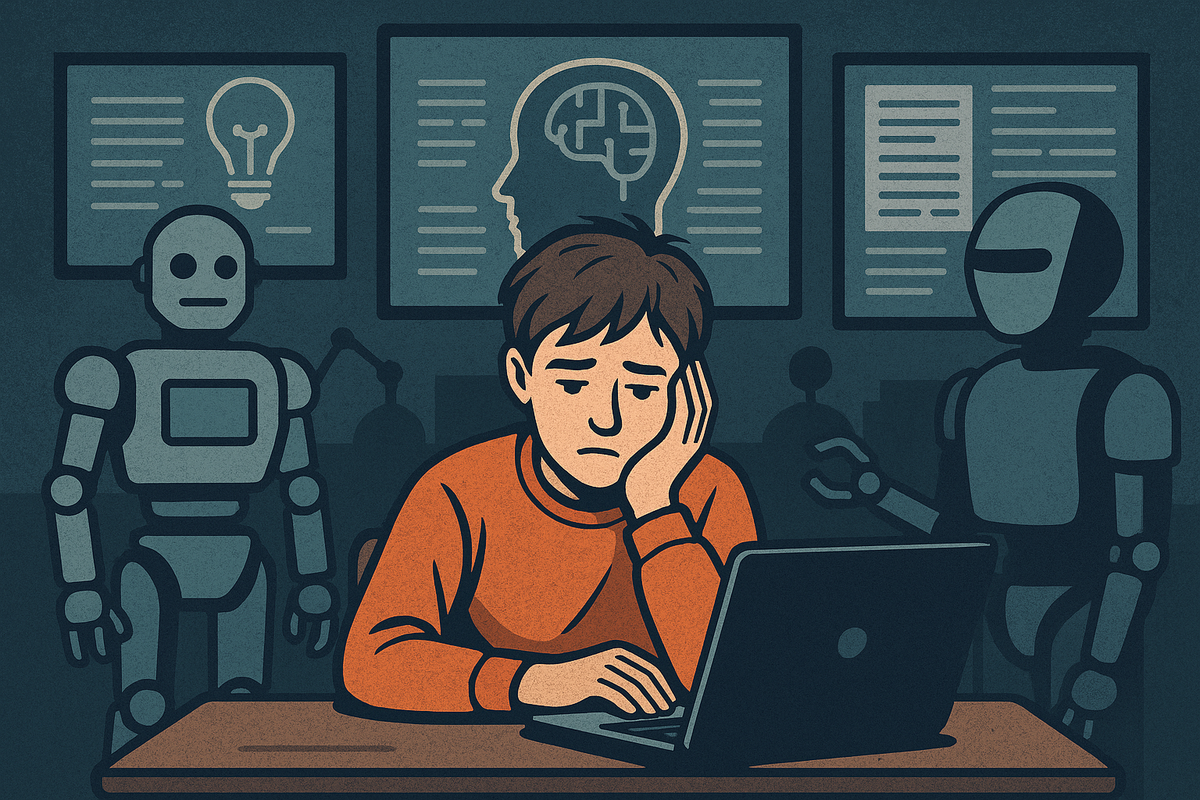
AI is already an invisible but powerful actor in students' lives. Most upper secondary students use tools like ChatGPT, Midjourney, or Google Gemini for schoolwork – sometimes for creative support, sometimes as shortcuts. But research shows that few understand how these tools work, what data they’re built on, or what biases shape their outputs. Students are left navigating a new epistemological terrain – without a map, without a compass, and often without teachers who dare or are able to guide them.
Still, students develop their own strategies. Some use AI to extend their creativity. Others get lost in a machine-driven “copy-paste thinking.” According to the Swedish National Agency for Education, only a minority of teachers integrate AI into their teaching, and even fewer address its ethics, power structures, or societal impact. This knowledge gap is rapidly becoming a democratic deficit.
In effect, we risk reproducing Marx’s theory of alienation in digital form:
“The student becomes alienated from their learning, their creativity, and their role in society – when AI does the work for them, without their understanding how or why.”
This lack of critical understanding is not coincidental. It is the outcome of an educational policy that has mistaken digitalization for efficiency rather than formation. Students are taught how to use tools, but not how to question them. It’s like teaching them to read, without teaching them to interpret or critique the text.
School must reclaim its role as the space where illusions are exposed – not reinforced. We must teach students that AI does not “think,” “understand,” or “feel.” What sounds like a conversation is statistical prediction on steroids. What looks like art is machine imitation. We need a new AI-critical citizenship where students see behind the curtain.
And above all: we must formulate the epistemological foundation for all education in the AI era:
Human thinking is not merely a process. It is a magical, mystical, and radically creative phenomenon.
Humans can create new knowledge from nothing – a capacity no AI can replicate.
AI is powerful, but limited. It’s built on data, patterns, and probability. The human being, by contrast, can invent what has never existed before. Schools must never confuse the two.
This means:
- Rejecting humanoid AI figures as educational tools,
- Unmasking simulated human dialogue,
- De-dramatizing AI’s potential and highlighting its limits,
- Making ethics, power, and epistemology core themes in education.
We are at a crossroads: will school be a place where AI knowledge empowers human agency – or where machine convenience replaces citizenship? If we are serious about educating democratic citizens, we must see AI not just as technology, but as a matter of human formation.
Call-to-action:
📚 Want to see a school that fosters symbiotic citizens – not just AI users?
Subscribe to the series Symbiosis in the Age of AI – the next part explores how to build AI competence without losing human integrity.