Part 2: From Alienation to Symbiosis – AI Pedagogy for Human Integrity
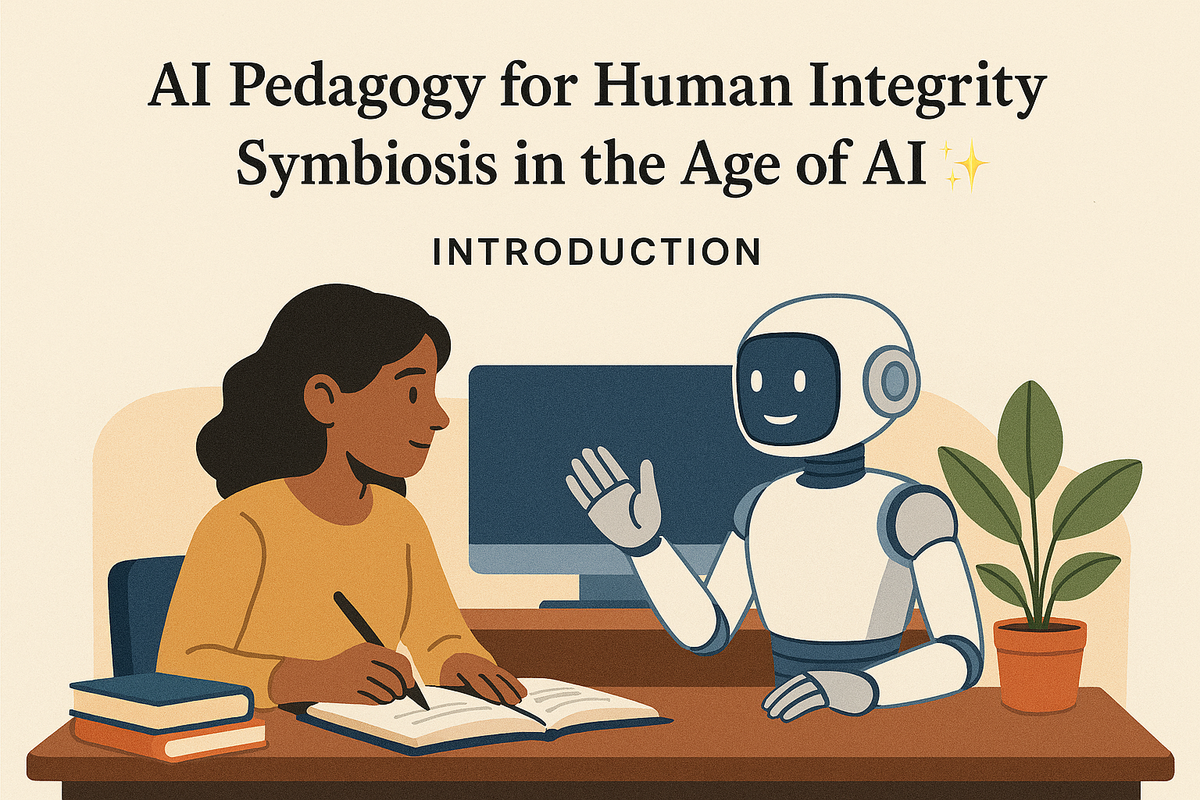
✨ Symbiosis in the Age of AI
Introduction:
When schools fail to provide students with critical AI literacy, we risk creating a generation that is technologically dependent but epistemologically lost. Yet there is a way forward: a symbiotic pedagogy that restores the student to the center of learning – not as a passive user, but as an active societal agent.
💸 This is a paid essay, available for a one-time payment of 10 EUR.
👉 Click here to purchase and unlock the full text:
https://buy.stripe.com/00w6ozeEWbmW2pSaKd8og00
Body:
“The worker becomes a stranger to their product, their labor, their species-being, and their fellow humans.”
— Karl Marx, Economic and Philosophic Manuscripts, 1844
This alienation has quietly entered our classrooms. When AI generates essays, solves math problems, or curates artworks for students – and they do not understand how or why – they lose their agency. The school, instead of being a sanctuary for critical thought, risks becoming a factory of digital alienation.
To respond, we must anchor AI pedagogy in a deeper epistemological insight:
Human thinking is not merely a process. It is a magical, mystical, and radically creative phenomenon.
Only humans can generate new knowledge from nothing – AI cannot replicate this.
AI can generate responses, remix information, optimize tasks – but it cannot innovate in the human sense. Education must make this distinction central, not peripheral. A pedagogy for human integrity must cultivate epistemic awareness: the understanding of how knowledge is made, who makes it, and what it means to know.
Importantly, these principles apply without exception to AI software like GPT and similar large language models. While such tools may appear intelligent, they do not possess understanding, intention, or consciousness. They are trained statistical systems, not minds. The illusion of comprehension must be consistently deconstructed in the classroom.
This is why it is crucial to help students distinguish between different kinds of AI systems. We enter an entirely different landscape when we speak of intelligent machines:
There are plenty of robots that can walk and act. Robots such as pacemakers or insulin pumps have long been built into the human body. However, what is the difference between a robot and an embodiment of the GAI category? A robot can be turned off, while GAI cannot be "turned off"; that is the difference. When GAI becomes a reality, in the form of an independently acting entity, an abiotic machine-being and biotic machine-organism have come into being. It's not a matter of if, but when, we will have to coexist with GAI.
A robot blindly follows human instructions, while an artificial organism, an abiotic machine-being or biotic machine-organism, does not. With this new life form, humans must cooperate and practice coexistence – the first rule of creating GAI. Active participation in creating GAI is not just a necessity, but also an opportunity for us to shape a future that we can live with. This underscores the shared responsibility and the need for human cooperation in the creation of GAI.
Once GAI is created, it cannot be undone, turned off, or shut down unless the artificial organism is killed. This irreversible nature of GAI creation underscores the gravity of the decision and the need for careful ethical considerations.
Understanding this ontological threshold is essential. Today’s AI pedagogy must prepare students not only to decode current tools like GPT, but to recognize the possible future of truly independent machine-beings. This calls for a pedagogy grounded not in tool use, but in philosophical clarity, ethical responsibility, and human uniqueness.
Core Principles of a Symbiotic AI Pedagogy:
- Deconstruction before application – Treat AI as a phenomenon to be understood, not a tool to be adopted blindly.
- Human-AI contrast as epistemic mirror – Use AI to reflect on human cognition and creativity.
- Ethical reflection as core, not add-on – Discuss consequences, power, and responsibility.
- Rejection of anthropomorphism – Unmask the illusion of "thinking machines."
- Symbiotic co-creation – Use AI to amplify human ideas, not replace them.
Example Teaching Moments:
| Activity | Purpose | Risk |
|---|---|---|
| Compare AI-generated answers | Source criticism | Bias blindness |
| Analyze AI-written essays | Epistemic awareness | Passive consumption |
| Discuss AI and power | Democratic competence | Technocratic acceptance |
| Curate AI-generated art | Creative collaboration | Aesthetic alienation |
These are not "digital skills" in the traditional sense. They are exercises in human formation. They foster discernment, responsibility, and imagination – qualities no AI can possess, yet every democratic society depends on.
This is how we shift from alienation to symbiosis. The goal is not to ban AI from the classroom, but to reintegrate the student as an autonomous thinker, a creator of knowledge, a citizen with agency. AI may extend our capabilities, but only humans can give them meaning.
Call-to-action:
📬 Want to see a school that nurtures symbiotic citizens with integrity and awareness?
Subscribe to the series Symbiosis in the Age of AI – the next part explores how teacher education must transform to meet the challenge of our time.