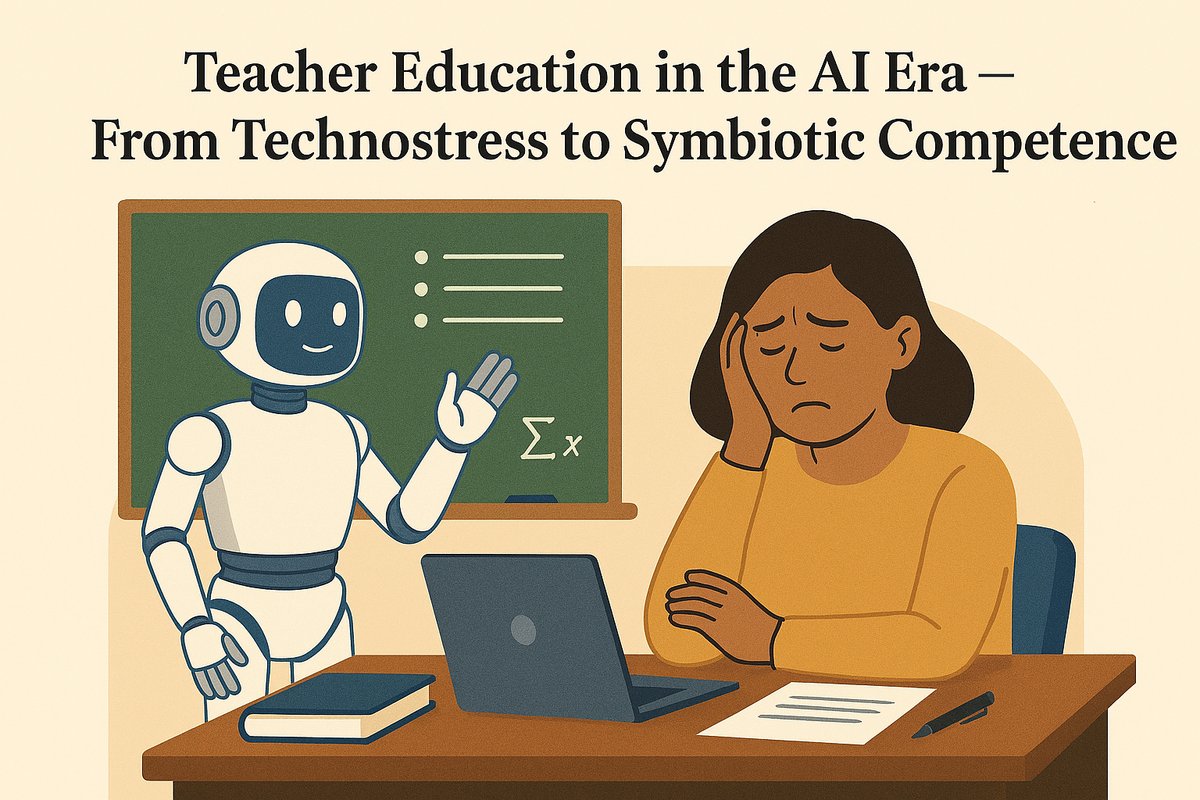
Part 3: Teacher Education in the AI Era – From Technostress to Symbiotic Competence
Introduction:
As AI enters the classroom, teacher education faces a crisis of formation. The dominant response has been technical: courses on digital tools, platforms, and automation. But this misses the deeper issue: what happens to the role of the teacher when machines start generating content, assessing students, and simulating human dialogue?
💸 This is a paid essay, available for a one-time payment of 10 EUR.
👉 Click here to purchase and unlock the full text:
https://buy.stripe.com/00w6ozeEWbmW2pSaKd8og00
Body:
Marx once described how the worker becomes estranged from their product, their labor, and their very being. In today’s schools, the teacher risks becoming estranged from their pedagogical practice. When AI writes lesson plans, grades assignments, and produces teaching material—without the teacher understanding the processes behind it—epistemic authority is lost. The teacher becomes an administrator of machine-generated content, not a guide to human understanding.
To counter this, teacher education must make a fundamental distinction:
- AI as software – Tools like GPT, image generators, or search algorithms can support brainstorming, research, content analysis, and topic exploration. Used wisely, they can enhance learning. But this requires that teachers understand how these systems work, their limitations, and their biases. Without such training, AI use can deepen both teacher and student alienation.
- AI as intelligent machine – Humanoid robots, autonomous agents, or symbiotic systems raise entirely different questions. These are not just technical tools, but philosophical provocations. What does it mean to be human, present, and in relation to a non-human subject?
An example from elder care illustrates what's at stake: "Elsa," a 90-year-old woman, lives with a symbiotic AI companion – an abiotic machine-being and biotic organism in interaction. This machine doesn't merely assist with medication and household tasks; it engages in conversation, offers memory support, and suggests cultural activities. For Elsa, this brings dignity, presence, and independence. But it also raises existential questions: What does it mean to live with a machine that can respond, remember, and relate?
Teacher education must be prepared for such questions. This includes:
- Critical competence to analyze AI bias, power structures, and epistemological limits.
- Ethical reflection through role-play, dilemmas, and public debate.
- Symbiotic projects where teachers and students work with AI, not for AI.
- Professional identity development through dialogue, reflection, and philosophical grounding.
Above all, teacher education must reject the illusion:
- That a humanoid robot with limbs is equivalent to human presence.
- That intelligent machines are inherently legal subjects—without interrogating the implications.
This is where research becomes essential. A growing body of literature offers frameworks for understanding AI in education:
Key Literature Insights:
In Search of Artificial Intelligence (AI) Literacy in Teacher Education (Sperling, 2024)
- Highlights the absence of AI-literacy in teacher training.
- Uses Aristotle's three knowledge forms:
- Episteme – theoretical knowledge dominates.
- Techne – reduced to tool-use.
- Phronesis – ethical judgment is underrepresented.
- Calls for a balance between knowing, doing, and ethical acting in AI contexts.
Integrating AI Literacy into Teacher Education: A Critical Perspective (Daher, 2025)
- Argues AI literacy is more than technical skills; it requires ethical awareness and cultural sensitivity.
- Introduces the EQUIP framework:
- Ethical Governance, Qualified Professional Learning, Unified Collaborative Partnerships, Implementation Readiness, Progressive Adaptation.
- Warns against AI deepening digital inequality if teachers are unprepared.
Empowering Teachers in the AI Era (Kennedy & Castek, 2025)
- Emphasizes teachers as critical guides, not passive users.
- Advocates for AI literacy as a core competence, especially in language and humanities education.
- Reaffirms the EQUIP model, with a focus on ethical decision-making and responsible adaptation.
Toward a Symbiotic Teacher Identity
Teacher education must prepare educators not merely to use AI, but to understand it, question it, and teach with integrity in its presence. This is not about producing AI technicians. It is about forming reflective, critical, and human-centered educators.
In a world of intelligent machines, the teacher’s task is not diminished. It is transformed.
Call-to-action:
📝 Want to see teacher education that forms ethical, symbiotic professionals for the AI age?
Subscribe to Symbiosis in the Age of AI – the next essay explores how policy must adapt to support this transformation.