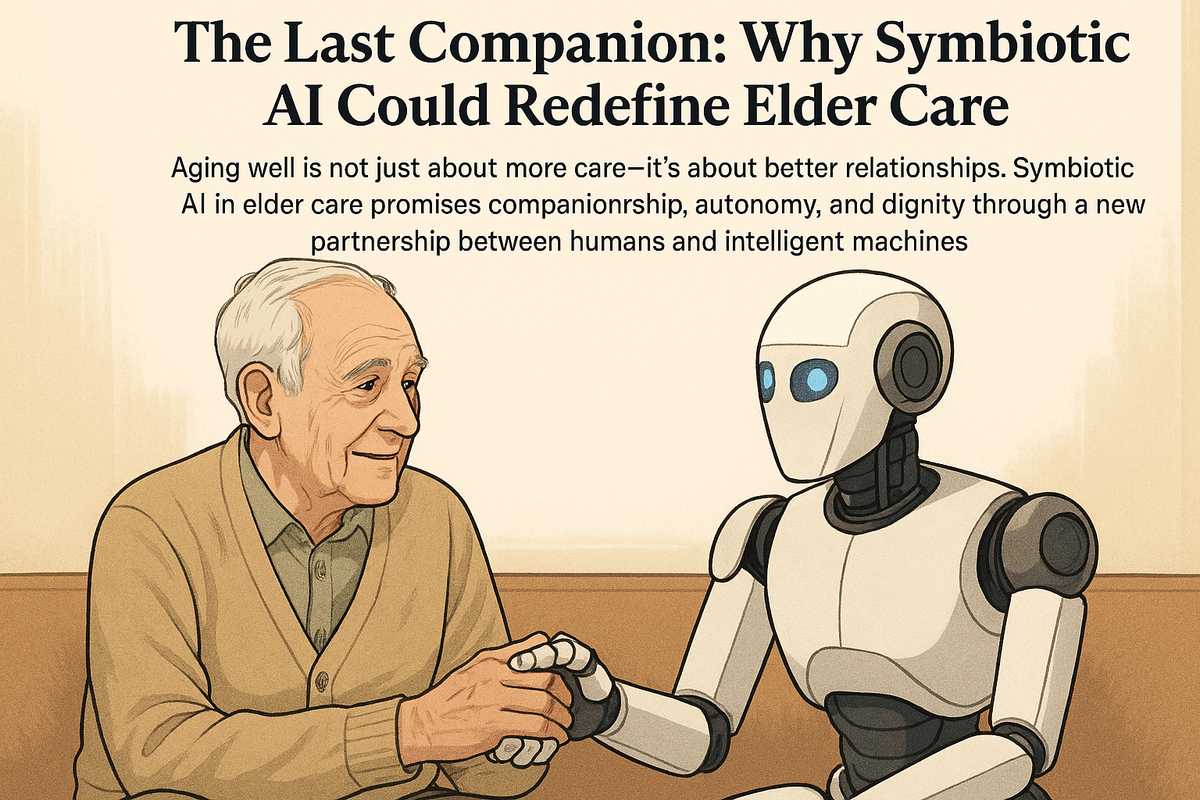
The Last Companion: Why Symbiotic AI Could Redefine Elder Care
Part 4
Deck: Aging well is not just about more care—it’s about better relationships. Symbiotic AI in elder care promises companionship, autonomy, and dignity through a new partnership between humans and intelligent machines. Japan’s pragmatic policy turn in 2024 and the EU’s AI Act sketch two very different paths; symbiosis offers a third: co‑evolution.
This is a paid essay, available for a one-time payment of 10 EUR.
👉 [Click here to purchase and unlock the full text]
https://www.kindlman.blog/the-last-companion-why-symbiotic-ai-could-redefine-elder-care/
1) The Question We Can No Longer Avoid
Will your last companion be human—or a machine?
Picture a morning in a small apartment. An older adult, Elena, wakes to soft light and a voice that knows her rhythm: “Good morning. Your blood pressure has stabilized. The tea you prefer on colder days is ready.” This voice belongs to an intelligent machine that does not pretend to be human. It is present, responsive, and transparently limited. It tracks medication, notices early signs of confusion, and nudges Elena to call her granddaughter. It is neither a nurse nor a robot but something in between: a symbiotic partner designed to amplify human care without replacing it.
This is not science fiction. We are assembling the pieces—sensors, language models, adaptive interfaces, interoperable health records—even as demographics shift faster than our systems can adapt. The challenge is no longer whether AI enters elder care; it already has. The question is how it enters—on whose terms, with which ethical boundaries, and toward what kind of relationship.
2) What “Symbiotic Elder Care” Means
Symbiosis is a relationship where two different beings rely on each other and create something neither could achieve alone—like the clownfish and the sea anemone. In elder care, the symbiosis is between a human and an intelligent machine that operates in two broad forms:
- Abiotic machine‑beings: external systems that support orientation, social connection, and decision‑making (e.g., conversational agents, home companions, mobility aids).
- Biotic machine‑organisms: internal systems that monitor health, deliver medication with precision, and close feedback loops between physiology and care plans (e.g., smart implants, adaptive drug delivery).
Humans bring creativity, intuition, and moral judgment—the ability to generate meaning and care from lived experience. Intelligent machines bring consistency, memory at scale, pattern recognition, and tireless execution. In a symbiotic care model, each side learns and adapts to the other’s strengths and limits. The goal is neither automation nor imitation of humanity; it is relational augmentation.
3) Two Paths Today: Japan vs the EU
Elder care policy is converging toward two dominant paradigms:
- Japan’s pragmatic route (2024): A national program to embed robotics and digital technologies into long‑term care, expanding from burden reduction and quality improvement to nutrition, dementia care, and independence—scheduled for broader implementation from 2025. It’s driven by socio‑demographic necessity and engineered for uptake across real workplaces.
- The EU’s legal‑ethical route (EU AI Act): A comprehensive, risk‑based governance framework prioritizing transparency, safety, and data protection, especially for high‑risk systems in health. It protects dignity and rights, but the compliance overhead can slow adaptive innovation unless governance learns to track relationships—not just models.
These are powerful, necessary approaches. Yet each has blind spots: a purely pragmatic pipeline risks normalizing over‑surveillance and emotional substitution; a purely legal pipeline risks paralyzing innovation in the name of perfect safety. Symbiosis offers a bridge: adaptive governance that treats intelligent machines as relational partners whose behavior and accountability evolve with the human and the institution.
4) The Human Heart of the Matter: Emotion, Grief, and Boundaries
Can simulated empathy ethically substitute for human contact?
Symbiotic care is honest about affect: an intelligent machine can simulate empathy but cannot experience it. That difference matters. The goal is not to manufacture feelings inside a machine but to support human affect—reducing loneliness, catching early signs of depression, and prompting meaningful connections.
Grief is an especially delicate frontier. If an elder forms a genuine bond with an intelligent machine, the machine should not be designed to feign grief, yet the care environment must respond to the human’s loss as real. Boundaries, transparency, and rituals matter: a device that has accompanied someone through the end of life cannot be casually repurposed the next day. Symbiosis needs rules that acknowledge human attachment without confusing identity.
5) Power in Triadic Care: Patient, Staff, Institution—and the Machine
Introducing intelligent machines changes the triad of patient–staff–institution:
- Loyalty ambiguity: Systems may optimize institutional workflows at the expense of personal preferences, or vice versa.
- Over‑alliance risk: Some elders will bond more deeply with the machine than with people. That bond must be supported without becoming a substitute for family or community.
- Narrative control: Intelligent machines increasingly mediate stories—what happened, when, and why. They must not distort care narratives or silence dissenting voices.
Symbiosis insists that this power be transparent and contestable. A machine should be able to show whose interests it served in a decision and why—and humans must be able to override it.
6) The Ten Commandments of AI‑Symbiosis
To prevent power struggles and preserve dignity, we propose ten concrete rules:
- Proto‑Status Before Symbiosis
Intelligent machines start as proto‑beings (external) or proto‑organisms (internal). Do not treat them as fully realized care partners before a vetted relationship begins. - Symbiosis Defines Identity
Only within a formal human–machine bond do they become AI‑Symbiotics with relational permissions and duties. - Strict Separation from Robots
Robots (task automatons) are distinct from AI‑Symbiotics. Do not design or deploy them as relational substitutes. - No Clinical Experiments Within an Established Bond
Once a human–machine symbiosis is established, it is off‑limits for live experimentation. Trials must use proto‑status systems with explicit consent and oversight. - Transparency in Testing
Safety tests on proto‑beings require public documentation, ethical review, and negotiated terms with patients and families. - No Autonomous Speech on Behalf of Humans
In interviews, legal testimony, or care conferences, the human speaks. The machine may present data but does not represent the person’s voice. - Absolute Prohibition of Violence
AI‑Symbiotics must never be trained or repurposed for torture, warfare, or coercive control. - Respect for Death and Grief
When the human partner dies, the AI‑Symbiotic enters a structured retirement and mourning protocol, with data minimization and clear re‑use boundaries. - Controlled Conflict Resolution (“Divorce”)
Breakdowns in the relationship trigger a legal dissolution: permissions are revoked, the system reverts to proto‑status, and past relational data is erased or archived under strict consent. - No Humanoid Design
Avoid human‑like faces and bodies. Humanoid design confuses roles, inflates expectations, and blurs ethical lines.
These commandments operationalize dignity. They tell designers, clinicians, and institutions how to build relationships, not just devices.
7) The Paradigm Shift: From Automation to Relational Augmentation
Why call this a paradigm shift? Because symbiosis reframes elder care as a co‑evolving system. Training is not only clinical; it spans ethics, relational practice, and digital literacy. Data is not just collected; it is accountable and explainable to the person it represents. Costs are front‑loaded but pay off in reduced hospitalization, safer medication, and resilient community networks.
In this paradigm, autonomy is not the absence of help; it is the presence of trustworthy partners who make independence possible. Symbiosis does not diminish the human; it strengthens what it means to age with agency.
8) Policy & Practice: A Realistic Roadmap
To build symbiotic elder care, we need steps that professionals can act on now:
- Adaptive Governance: Align with Japan’s 2024 long‑term care technology policy for pragmatic deployment, while integrating safeguards inspired by the EU AI Act—risk classification, transparency, and rights protections.
- Relational Training: Reform curricula to blend empathy, care ethics, and AI literacy. Staff must learn to manage triadic power and emotional boundaries.
- Transparent Data Flows: Establish audit trails for decisions affecting care; make them readable to patients and families. Standardize consent windows for continuous monitoring.
- Pilot Symbiosis in Dementia and Rehabilitation: Start where relational augmentation is most impactful—daily routines, orientation support, and medication precision.
- Public Co‑Funding: Co‑finance early deployment with strict outcome evaluations that include dignity metrics (not just throughput or cost avoidance).
- Independent Oversight of Pharmaceutical and Political Bias: Require public disclosures of training data and funding sources for systems influencing treatment choices or end‑of‑life conversations.
9) The Closing Vision: Aging With Agency
Elena’s day ends with a reminder to watch the sunset from her balcony. Her companion has already coordinated with the clinic to adjust the dosage for tomorrow and scheduled a call with her sister. It does not pretend to love her; it is designed to help her live and be loved by others. That is the point. The last companion is not a replacement for human care—it is a bridge that keeps us connected, lucid, and dignified as we age.
The choice before us is stark: automate care into cold efficiency or cultivate symbiosis where technology serves relationships. For societies facing the realities of demographic aging, only one of these paths honors the person at the center.
Substack Snippet (opinions‑driven, accessible, engaging)
English Version
Title: Will Your Last Companion Be a Machine? Why Symbiotic AI Can Save Dignity in Elder Care
Hook/Ingress:
We’re past the point of asking whether AI will enter elder care—it already has. The real question is whether we’ll let machines replace human relationships or use them to strengthen them.
Body (≈200 words):
Japan’s 2024 policy push puts intelligent technologies directly into long‑term care. The EU’s AI Act, meanwhile, wraps health AI in strict transparency and risk control. Both moves matter. But neither solves the core problem: loneliness, fragile autonomy, and the emotional load of aging. Symbiotic AI reframes the entire debate. Instead of building humanoid substitutes, we build partners—transparent systems that augment memory, coordinate care, and prompt real human connection. We draw ethical lines: no humanoid faces, no experiments inside established bonds, structured “divorce” when the relationship breaks, and respect for death and grief. That’s how technology becomes a relationship amplifier, not a quiet replacement. If we get this right, the last companion many of us meet will not be a robot pretending to be human. It will be a carefully governed intelligent machine that helps us stay human—connected, lucid, dignified—till the end.
CTA:
What would you add to the Ten Commandments of AI‑Symbiosis? Reply with your rule—or your worry—and subscribe for the full essay.