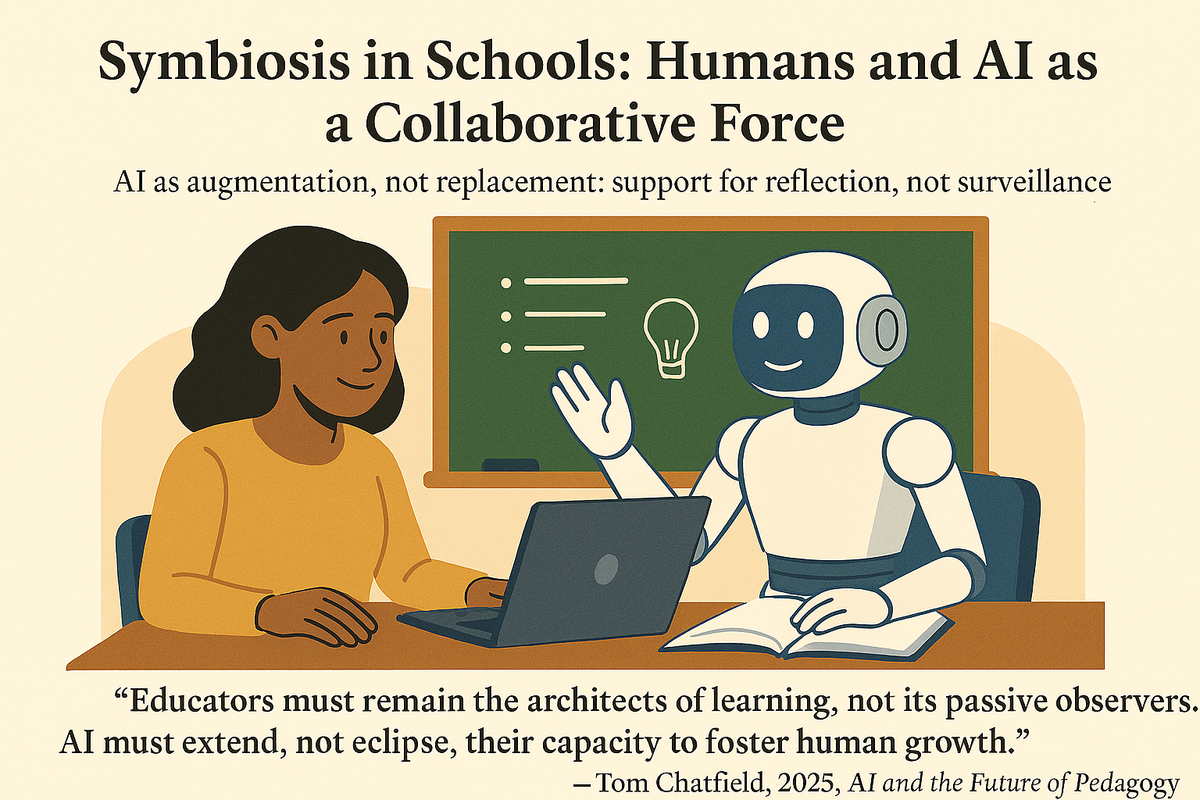
Essay: Part 4A_Symbiosis in Schools: Humans and AI as a Collaborative Force
Subtitle: Pedagogical symbiosis in the classroom
AI as augmentation, not replacement: support for reflection, not surveillance
“Educators must remain the architects of learning, not its passive observers. AI must extend, not eclipse, their capacity to foster human growth.”
— Tom Chatfield, 2025, AI and the Future of Pedagogy
“High-risk AI systems used in education must be subject to appropriate human oversight to prevent automation bias and protect learners’ fundamental rights.”
— Article 14, Regulation (EU) 2024/1689 – Artificial Intelligence Act
This is a paid essay, available for a one-time payment of 10 EUR.
👉 [Click here to purchase and unlock the full text]
https://www.kindlman.blog/title-part-4a_symbiosis-in-schools-humans-and-ai-as-a-collaborative-force/
Banning AI in education means denying students a key future skill. Instead of seeing AI as a threat, we should view it as a catalyst for creativity, critical thinking, and democratic participation. This essay explores how schools can develop pedagogy based on symbiosis – a collaboration where humans and AI evolve together.
What is Symbiosis in Education?
Symbiosis is a design principle based on mutual dependence: AI amplifies human creativity and analysis but never replaces it. Humans contribute empathy, ethical judgment, and contextual understanding. AI offers rapid analysis, language support, and simulations.
Tasks must require human reflection and source criticism. AI is used to broaden perspectives, not to deliver ready-made answers. This strengthens metacognition – students learn how they think and why they make certain choices. Symbiosis turns teachers into learning environment designers, not mere controllers. It equips students to become active knowledge creators, not passive consumers.
But symbiosis is more than a tool-sharing model. In its deeper sense, it is a new way of thinking about knowledge and learning. Inspired by biology, where two different organisms live together to mutual benefit, AI-human symbiosis in education means each side contributes something essential. Humans bring insight, context, intuition; AI brings capacity, memory, simulation. Like the clownfish and sea anemone, this partnership works best when built on difference, not similarity. Unlike a traditional assistant, AI in a symbiotic setup isn’t there to mimic or replace the teacher – it is there to extend what no single human can do alone. The classroom becomes an ecosystem of mutual growth.
AI is no longer the "threat" but the amplifier. It helps preserve insights, visualize ideas, simulate consequences. The teacher's role is not diminished but deepened – as a symbiosis facilitator.
The teacher as environmental designer: AI should strengthen the teacher's role, not undermine it
Tom Chatfield’s white paper (2025) emphasizes that teachers must not become passive managers of automated systems. Instead, they must be empowered to design learning environments where AI is a tool of reflection and exploration. Chatfield argues that pedagogy must guide technology, not the other way around. This includes making students reflect on their learning process, not just output.
AI as augmentation, not replacement: support for reflection, not surveillance
5. Didactic Toolbox: Five Symbiotic Lesson Formats
AI symbiosis in teaching is not about replacing the teacher but about creating a dynamic interplay in which AI amplifies human creativity, critical thinking, and responsibility. Below are five formats trialed in classrooms and supported by current research.
5.1 AI Socrates (critical dialogue)
Purpose: Train argumentation, source criticism, and reasoning.
Setup: The teacher provides a framing question (e.g., 'What caused the French Revolution?'). Students use an AI chat as a question generator. The AI proposes counter-questions, contrasts, and sources. Students select the most relevant questions, justify their choices, and build a human-written argument.
Assessment: Focus on citations, logical structure, and original analysis.
Why Symbiosis?: AI broadens perspectives; the student steers the dialogue and owns the content.
Research tie-in: Socratic questioning with AI increases deep learning when teachers define the boundaries (APA, 2024).
5.2 Prototype Studio (project-based learning)
Purpose: Combine creativity with data-driven exploration.
Setup: Students identify a local problem (e.g., noise near the school). AI assists with idea generation, simple simulations (basic models, data trends), and drafting solutions. Students take manual measurements, compare them with AI suggestions, and document differences.
Assessment: Prototype, project log, and a reflective comparison between AI support and the students’ own data.
Research: Project-based learning with AI strengthens motivation and personalization when the task requires human critical synthesis (MDPI, 2023; Campus Technology, 2024).
5.3 Writing Coach (metacognitive writing process)
Purpose: Strengthen structuring and revision skills in language arts.
Setup: Students prepare an outline and thesis. AI suggests alternative structures (headings, transitions), stylistic support, and examples of counterarguments. The student chooses, rewrites, and annotates: 'This suggestion worked because X; I rejected Y due to bias/hallucination.'
Assessment: Annotated process + final version.
Ethics: No emotion inference; all use under human oversight in line with the AI Act (Swiss Cyber Institute, 2024).
5.4 Data Detective (source criticism & statistics)
Purpose: Learn to interpret data, detect bias, and understand model limitations.
Setup: AI generates hypotheses and summarizes articles; students fact-check against original sources, identify weaknesses (sampling, measurement error), build their own chart, and interpret differences.
Assessment: Source-critical report with clear argumentation.
Policy Support: Chatfield advocates transparency + mastery-based assessment (Sage, 2024).
5.5 Reflection Loops (metacognition across subjects)
Purpose: Make thinking visible; link process to outcomes.
Setup: Each AI-supported step uses 'reflection cards' (What did AI provide? What did I assume? What did I change? Why?). The teacher collects the cards as formative assessment.
Research/Practice: The APA report highlights that psychologists support safe and effective AI use without disrupting social learning—reflection loops are central (APA, 2024).
Tips for Teachers
Plan AI use as support, not as an answer key.
Use reflection cards to make thinking visible.
Be transparent with students about AI’s limitations.
Common Pitfalls
Automation bias: students accept AI responses without scrutiny.
Overuse: AI substitutes for human dialogue.
Insufficient source criticism of AI-generated data.
Examples of Student Reflection
'AI suggested X, but I chose Y because the source was more credible.'
'I changed the structure to fit my thesis.'
Policy Appendix: Practical Recommendations for Schools
A. Governance and Compliance: Define permitted use cases; make human-in-the-loop the default; protect data and maintain audit logs.
B. Pedagogy and Assessment: Mastery-based assessment, reflection cards, critical source review.
C. Infrastructure and Equity: Guarantee access; provide teacher CPD with testbeds; build on open resources.
D. Communication: Transparency sheets and student contracts.
E. Follow-up: Annual pedagogical review and student panels.
Commented Reference List
• NOLAI (Radboud University): A national lab developing AI prototypes in schools with a focus on ethics and pedagogy.
• AI4T (EACEA): Teacher training that increases confidence and competence in AI use.
• Tom Chatfield, Sage White Paper: Advocates mastery-based assessment and teachers as designers.
• EU AI Act: Risk-based model and ban on emotion analysis.
• APA Monitor: Trends in K-12 and psychological research on AI.
• Stanford SCALE: Data on AI use in teaching.
NOLAI – Netherlands:
This national initiative led by Radboud University brings together schools, universities, and industry to co-create AI tools tailored for classrooms. One standout prototype is a reading comprehension coach that adjusts the complexity of questions based on student input. Teachers remain in control, curating which questions are posed and adding deeper prompts. In classroom trials, students were asked to reflect on which AI-generated questions helped them think more critically and why. These meta-cognitive exercises helped solidify source criticism and self-regulation. Early results showed improved reading engagement, especially among middle-performing students.
AI4T – France, Ireland, Italy, Luxembourg, Slovenia:
A major Erasmus+ project reaching over 1,000 teachers through a MOOC and open textbook. In language learning, students use AI-driven translation tools as a rough draft starting point. The core learning activity involves revising the AI output, comparing alternatives, and explaining their editorial decisions. Teachers report higher motivation in writing tasks and better awareness of grammatical nuance. The project also produced guidelines for transparent AI use in formative assessment.
Deep-Dive Box: AI-Socrates – Critical Dialogue
Purpose: Train argumentation and source criticism.
Setup: AI generates probing questions on a chosen theme, such as "Was the French Revolution inevitable?" Students then select the most relevant questions, justify their selections, and construct arguments using multiple sources. Teachers evaluate not just the answer, but the quality of reasoning and source use. In pilot programs, students reported enjoying the feeling of having a "challenger" in the room, while teachers noted increased rigor in debate preparation.
In Part 4B, we explore how these pedagogical ideas scale into systemic change: future-ready institutions, ethical frameworks, and assessment reform.